








1Overview
Market Overview
Real data. Local insights. Smarter decisions.
Use this real-time market snapshot to understand where Matthews stands today—and what it could mean for your purchase plan.
Data is updated monthly.
Active Price Cuts
Active listings with recorded price cuts.
Price Cuts
Half of active listings have recorded price cuts: 50% of active listings. Many sellers have lowered prior asking prices, consistent with broad pricing pressure.
Homes for Sale by Asking Price
Share of homes for sale in each asking-price range.
Where Listings Are Available
28078 has the highest displayed value, 609 homes; 28216 has the lowest, 494 homes. The gap is 115 homes.
Active IDX Broker / Canopy MLS inventory · Cached listing observations Jul 10, 2026–Oct 24, 2026
Welcome to our guide and market statistics page for buyers comparing homes with home offices in NC, where the goal is to help you read listings with more context than photos, room counts, and asking prices alone can provide. The guide already includes several built-in areas that work together as a practical path through the search: "Overview / Is Now a Good Time to Buy?" helps frame current conditions and whether the timing feels reasonable for your goals; "Neighborhoods / Do I Want to Live Here?" helps you think beyond the house itself and consider commute patterns, community feel, nearby services, and the kind of day-to-day setting that supports working from home; "Affordability / Can I Afford This Area?" helps you compare price ranges, monthly payment comfort, taxes, insurance, utilities, and the possible premium attached to a better floor plan or dedicated office; "Schools / How Are the Schools?" gives school-related context for buyers who need it now or may consider resale appeal later; "Market Outlook / What Does the Future Hold?" helps you interpret broader direction without assuming that every property or neighborhood will behave the same way; "Buyer Strategy / How Do I Win This Search?" focuses on offer preparation, prioritizing must-have features, and recognizing when a quiet workspace, strong internet options, or flexible layout is worth acting on; and "Market Recap / What Does It All Mean?" pulls the information back together so you can make a clearer decision instead of reacting to one listing at a time. For home-office buyers in NC, this matters because the best choice is rarely just the house with an extra room labeled as an office. A useful work-from-home setup may depend on privacy from main living areas, natural light, noise control, bedroom count, utility capacity, and how the space functions during a normal week. As you move through the guide, use the statistics and listing details together: market data can show how competitive a segment may be, while the property description and floor plan help determine whether a specific home truly fits your work, household, and long-term living needs.
Home Office Homes for Sale in Matthews — area-wide median $509K: What Makes a Home Office Truly Functional
A home office is most useful when it functions as more than leftover space. From an appraisal-minded perspective, buyers should look at whether the room has a practical size, good lighting, reasonable separation from household activity, and access to reliable power and internet. A front flex room, upstairs loft, converted bedroom, finished bonus room, or basement area can all serve different needs, but they are not equal in privacy or daily comfort. In NC, where many buyers balance hybrid work, family schedules, and commuting flexibility, the best setups often allow calls, focused work, and storage without taking away too much from the rest of the floor plan.

Home Office Homes for Sale in Matthews — area-wide $238/sqft: How Layout and Privacy Shape Daily Living
The location of the office within the home can affect both lifestyle fit and market perception. A room near the front entry may be convenient for client visits but may feel exposed for confidential work. A space near bedrooms can be quiet during the day but less ideal when household routines overlap. Open lofts can be attractive and flexible, yet they may not control noise well. Buyers should also consider whether the office reduces bedroom count, interrupts traffic flow, or limits future uses. A home that supports work, school projects, guests, and ordinary living will generally feel more adaptable than one with a single-purpose space that only works for one buyer profile.
Why Buyer Demand Remains Practical, Not Automatic
Demand for homes with home offices has remained meaningful because remote and hybrid work changed how many buyers evaluate space. Still, an office does not automatically create added value in every property. Its contribution depends on the overall layout, neighborhood price range, condition, and whether competing homes offer similar flexibility. Buyers should compare internet availability, HVAC comfort, electrical capacity, window placement, storage, and the ability to close a door for privacy. When the office is well integrated, it can broaden appeal to professionals, entrepreneurs, students, and households needing quiet flex space. When it feels improvised, cramped, or poorly located, it may be viewed simply as another room with limited usefulness.
Welcome to our guide and market statistics page for buyers comparing homes with home offices in NC, where the goal is to help you read listings with more context than photos, room counts, and asking prices alone can provide. The guide already includes several built-in areas that work together as a practical path through the search: "Overview / Is Now a Good Time to Buy?" helps frame current conditions and whether the timing feels reasonable for your goals; "Neighborhoods / Do I Want to Live Here?" helps you think beyond the house itself and consider commute patterns, community feel, nearby services, and the kind of day-to-day setting that supports working from home; "Affordability / Can I Afford This Area?" helps you compare price ranges, monthly payment comfort, taxes, insurance, utilities, and the possible premium attached to a better floor plan or dedicated office; "Schools / How Are the Schools?" gives school-related context for buyers who need it now or may consider resale appeal later; "Market Outlook / What Does the Future Hold?" helps you interpret broader direction without assuming that every property or neighborhood will behave the same way; "Buyer Strategy / How Do I Win This Search?" focuses on offer preparation, prioritizing must-have features, and recognizing when a quiet workspace, strong internet options, or flexible layout is worth acting on; and "Market Recap / What Does It All Mean?" pulls the information back together so you can make a clearer decision instead of reacting to one listing at a time. For home-office buyers in NC, this matters because the best choice is rarely just the house with an extra room labeled as an office. A useful work-from-home setup may depend on privacy from main living areas, natural light, noise control, bedroom count, utility capacity, and how the space functions during a normal week. As you move through the guide, use the statistics and listing details together: market data can show how competitive a segment may be, while the property description and floor plan help determine whether a specific home truly fits your work, household, and long-term living needs.
What Makes a Home Office Truly Functional
A home office is most useful when it functions as more than leftover space. From an appraisal-minded perspective, buyers should look at whether the room has a practical size, good lighting, reasonable separation from household activity, and access to reliable power and internet. A front flex room, upstairs loft, converted bedroom, finished bonus room, or basement area can all serve different needs, but they are not equal in privacy or daily comfort. In NC, where many buyers balance hybrid work, family schedules, and commuting flexibility, the best setups often allow calls, focused work, and storage without taking away too much from the rest of the floor plan.
How Layout and Privacy Shape Daily Living
The location of the office within the home can affect both lifestyle fit and market perception. A room near the front entry may be convenient for client visits but may feel exposed for confidential work. A space near bedrooms can be quiet during the day but less ideal when household routines overlap. Open lofts can be attractive and flexible, yet they may not control noise well. Buyers should also consider whether the office reduces bedroom count, interrupts traffic flow, or limits future uses. A home that supports work, school projects, guests, and ordinary living will generally feel more adaptable than one with a single-purpose space that only works for one buyer profile.
Why Buyer Demand Remains Practical, Not Automatic
Demand for homes with home offices has remained meaningful because remote and hybrid work changed how many buyers evaluate space. Still, an office does not automatically create added value in every property. Its contribution depends on the overall layout, neighborhood price range, condition, and whether competing homes offer similar flexibility. Buyers should compare internet availability, HVAC comfort, electrical capacity, window placement, storage, and the ability to close a door for privacy. When the office is well integrated, it can broaden appeal to professionals, entrepreneurs, students, and households needing quiet flex space. When it feels improvised, cramped, or poorly located, it may be viewed simply as another room with limited usefulness.
Thinking About Moving to Matthews, NC?
Matthews, North Carolina, is a vibrant suburban town located just southeast of Charlotte. Known for its blend of small-town charm and metropolitan convenience, Matthews has become a sought-after destination for homebuyers seeking a balance between community feel and access to big-city amenities.
Families and professionals are drawn to Matthews for its reputable schools, such as Butler High School (rated 8/10), Crestdale Middle School, and Matthews Elementary, as well as its welcoming neighborhoods like Sardis Forest and Brightmoor. The town features popular parks like Squirrel Lake Park and Four Mile Creek Greenway, and boasts local favorites such as Stacks Kitchen and Seaboard Brewing, Taproom & Wine Bar.
With a convenient location just 25–30 minutes from Uptown Charlotte, Matthews offers an attractive mix of affordability, lifestyle, and access to employment centers, making it a top choice for those looking to buy a house in the area.
How Matthews Became What It Is Today
Matthews traces its roots back to the 1800s, originally developing as a small railroad stop and agricultural hub. The arrival of the Seaboard Air Line Railroad in the late 19th century spurred growth, and the town gradually evolved into a residential suburb as Charlotte expanded.
Key growth periods in the 1980s and 1990s saw Matthews transform from rural farmland into a thriving community, with new neighborhoods, shopping centers, and schools. The revitalization of downtown Matthews has preserved its historic character while adding modern amenities, attracting both new residents and local businesses.
Today, Matthews is recognized for its walkable downtown, annual festivals, and a strong sense of community, all of which contribute to its enduring appeal for homebuyers.
Why Buyers Choose Matthews Now
Living in Matthews means enjoying a suburban lifestyle with quick access to Charlotte’s job market. The town’s neighborhoods, such as Matthews Estates and Winterbrooke, offer a mix of established homes and newer developments, catering to a range of budgets and preferences.
Outdoor enthusiasts appreciate the extensive greenways and parks, including Squirrel Lake Park’s fishing pier and Four Mile Creek Greenway’s scenic trails. Matthews’ local dining scene, highlighted by spots like Stacks Kitchen, adds to the town’s appeal.
Most residents commute around 25–30 minutes to Uptown Charlotte, making Matthews a practical choice for those working in the city but seeking a quieter, family-friendly environment. Home prices vary by neighborhood, but the area generally offers more space and value compared to Charlotte’s urban core.
Matthews at a Glance for Homebuyers
Here’s a snapshot of key numbers and facts every buyer should know before diving deeper into the Matthews, NC, market:
| Metric | Typical Value or Range | Why It Matters |
|---|---|---|
| Median home price | $440,000 | Sets expectations for what most buyers will pay for a typical home. |
| Typical price range for most homes | $360,000–$600,000 | Covers the majority of single-family homes in popular neighborhoods. |
| Approximate property tax level | 0.80%–0.90% of assessed value | Impacts your annual housing costs beyond the mortgage. |
| Typical homeowner’s insurance range | $1,100–$1,700 per year | Essential for budgeting total monthly and yearly costs. |
| Median household income | $95,000 | Indicates local affordability and purchasing power. |
| Estimated population | 32,000 | Reflects the town’s size and community scale. |
| Typical one-way commute to Uptown Charlotte | 25–30 minutes | Shows how accessible Charlotte’s job market is from Matthews. |
What These Numbers Mean If You Are Buying
The median home price in Matthews, at $440,000, reflects the town’s strong demand and desirable location within the Charlotte metro area. With a median household income of $95,000, many local families find homeownership attainable, though competition can be strong for move-in-ready homes in top neighborhoods.
Property taxes in Matthews, typically ranging from 0.80% to 0.90% of assessed value, are moderate for North Carolina and help keep overall monthly payments manageable. Homeowner’s insurance, usually between $1,100 and $1,700 per year, is in line with regional averages and should be factored into your budget.
The typical price range of $360,000–$600,000 means buyers can find both starter homes and larger family properties, though inventory at the lower end can move quickly. Commute times of 25–30 minutes to Uptown Charlotte make Matthews a practical choice for those working in the city but seeking a quieter, suburban lifestyle.
Overall, buyers in Matthews face a market with steady demand and a mix of established and newer homes. While competition exists, especially in popular neighborhoods, buyers benefit from a range of options and a strong community infrastructure.
Quick Questions Buyers Ask About Matthews, NC
Q: Is Matthews a good place for families?
A: Yes, Matthews is known for its family-friendly neighborhoods, reputable schools like Butler High and Matthews Elementary, and abundant parks and recreation options.
Q: How long is the commute to downtown Charlotte?
A: The typical one-way commute to Uptown Charlotte is 25–30 minutes, depending on traffic and time of day.
Q: Are there affordable starter homes in Matthews?
A: While competition can be strong, homes in the $360,000–$400,000 range are available, especially in established neighborhoods.
Q: What are some popular neighborhoods to consider?
A: Sardis Forest, Brightmoor, Matthews Estates, and Winterbrooke are all well-regarded options with a variety of home styles.
Q: Does Matthews have walkable areas or a town center?
A: Yes, downtown Matthews is walkable, featuring local shops, restaurants, and community events throughout the year.
What You Can Explore Next
In the following sections of this guide, you’ll find detailed spotlights on Matthews’ neighborhoods, a breakdown of cost of living and affordability, in-depth school analysis, and a synthesis of current market trends. We’ll also cover buyer strategies, relocation tips, and a step-by-step roadmap for making your move to Matthews, NC, as smooth as possible.
Keep reading if you want straightforward answers to the questions almost everyone asks before they commit to buying in Matthews.
Data Sources and References
Summaries and estimates in this section draw on typical patterns from sources such as:
- Redfin market reports
- Realtor.com and local MLS data
- U.S. Census and North Carolina state government dashboards
Welcome to our guide and market statistics page for buyers comparing homes with home offices in NC, where the goal is to help you read listings with more context than photos, room counts, and asking prices alone can provide. The guide already includes several built-in areas that work together as a practical path through the search: "Overview / Is Now a Good Time to Buy?" helps frame current conditions and whether the timing feels reasonable for your goals; "Neighborhoods / Do I Want to Live Here?" helps you think beyond the house itself and consider commute patterns, community feel, nearby services, and the kind of day-to-day setting that supports working from home; "Affordability / Can I Afford This Area?" helps you compare price ranges, monthly payment comfort, taxes, insurance, utilities, and the possible premium attached to a better floor plan or dedicated office; "Schools / How Are the Schools?" gives school-related context for buyers who need it now or may consider resale appeal later; "Market Outlook / What Does the Future Hold?" helps you interpret broader direction without assuming that every property or neighborhood will behave the same way; "Buyer Strategy / How Do I Win This Search?" focuses on offer preparation, prioritizing must-have features, and recognizing when a quiet workspace, strong internet options, or flexible layout is worth acting on; and "Market Recap / What Does It All Mean?" pulls the information back together so you can make a clearer decision instead of reacting to one listing at a time. For home-office buyers in NC, this matters because the best choice is rarely just the house with an extra room labeled as an office. A useful work-from-home setup may depend on privacy from main living areas, natural light, noise control, bedroom count, utility capacity, and how the space functions during a normal week. As you move through the guide, use the statistics and listing details together: market data can show how competitive a segment may be, while the property description and floor plan help determine whether a specific home truly fits your work, household, and long-term living needs.
What Makes a Home Office Truly Functional
A home office is most useful when it functions as more than leftover space. From an appraisal-minded perspective, buyers should look at whether the room has a practical size, good lighting, reasonable separation from household activity, and access to reliable power and internet. A front flex room, upstairs loft, converted bedroom, finished bonus room, or basement area can all serve different needs, but they are not equal in privacy or daily comfort. In NC, where many buyers balance hybrid work, family schedules, and commuting flexibility, the best setups often allow calls, focused work, and storage without taking away too much from the rest of the floor plan.
How Layout and Privacy Shape Daily Living
The location of the office within the home can affect both lifestyle fit and market perception. A room near the front entry may be convenient for client visits but may feel exposed for confidential work. A space near bedrooms can be quiet during the day but less ideal when household routines overlap. Open lofts can be attractive and flexible, yet they may not control noise well. Buyers should also consider whether the office reduces bedroom count, interrupts traffic flow, or limits future uses. A home that supports work, school projects, guests, and ordinary living will generally feel more adaptable than one with a single-purpose space that only works for one buyer profile.
Why Buyer Demand Remains Practical, Not Automatic
Demand for homes with home offices has remained meaningful because remote and hybrid work changed how many buyers evaluate space. Still, an office does not automatically create added value in every property. Its contribution depends on the overall layout, neighborhood price range, condition, and whether competing homes offer similar flexibility. Buyers should compare internet availability, HVAC comfort, electrical capacity, window placement, storage, and the ability to close a door for privacy. When the office is well integrated, it can broaden appeal to professionals, entrepreneurs, students, and households needing quiet flex space. When it feels improvised, cramped, or poorly located, it may be viewed simply as another room with limited usefulness.
Important Information, Independent Verification & No-Advice Disclaimer
Information on this website is provided solely for general informational and educational purposes as an overview of housing and real estate markets. Content is compiled, aggregated, correlated, and summarized from multiple online and third-party sources and may include automated or AI-assisted content. Information may be inaccurate, incomplete, outdated, or inconsistent.
To the fullest extent permitted by applicable law, information is provided “as is” and “as available,” without express or implied representations or warranties regarding accuracy, completeness, timeliness, reliability, or suitability for any particular purpose. Prices, availability, statistics, estimates, and projections may change without notice. No property value, appreciation, income, investment return, or other financial result is guaranteed.
This website does not provide personalized financial, investment, legal, tax, lending, or appraisal advice. Helen Harp Realty is not a financial-planning or investment-advisory firm, and its general website content is not a recommendation that any particular property, transaction, or strategy is suitable for you.
Do not rely on this website as the sole basis for a purchase, sale, financing, or investment decision. Before acting, independently verify all material information with multiple reliable sources, including applicable government agencies and official records, and the relevant property owner, listing broker, homeowners’ association, lender, insurer, or service provider. Confirm matters such as property condition, square footage, taxes, zoning, permitted uses, school assignments, fees, assessments, insurance, financing, and current availability. Consult appropriately licensed professionals regarding your circumstances.
Merely accessing this website or reading its content does not establish a brokerage, agency, advisory, or fiduciary relationship. Any separately established brokerage or agency relationship remains governed by applicable law and the parties’ agreements.
To the fullest extent permitted by applicable law, Helen Harp Realty and the website’s operators disclaim liability for losses arising from errors, omissions, or reliance on general website information. Nothing in this disclaimer limits duties owed under an established brokerage or agency relationship, excuses misrepresentation or failure to disclose material facts, or waives any right, duty, or liability that cannot lawfully be waived.

Life in Matthews
Uptown provides a true sense of neighborhood. Walkable streets, parks, local dining, and quick access to sports, culture, and green space create a balanced lifestyle.
Explore Neighborhoods →
Get Local Guidance
Market moves fast. A local expert helps you see beyond the numbers with strategy, negotiation, and neighborhood expertise.
Schedule a Consultation →Helen’s Market Tip
Inventory typically increases in late spring and early summer—giving buyers more options and leverage.
Be prepared and gain pre-approval early to act with confidence.
2Neighborhoods
Neighborhoods
Neighborhood Comparison & Market Snapshot in Matthews, NC
When you’re looking to buy a house in Matthews NC, , the neighborhood you choose can make a big difference in price, lot size, and how quickly homes sell. This section compares several of the most popular neighborhoods in and around Matthews, giving you a clear picture of what to expect as a buyer.
Comparing neighborhoods side by side helps you see where your budget goes furthest, which areas move fastest, and where you’ll find the right mix of amenities and community feel.
Here is how current listing supply compares across Matthews’s neighborhoods and area groupings.
Neighborhood Inventory
Myers Park has the highest displayed value, 94 homes; Cotswold has the lowest, 65 homes. The gap is 29 homes.
Active IDX Broker / Canopy MLS inventory · Cached listing observations Jul 10, 2026–Oct 24, 2026
Inventory Snapshot by Area
Listed homes in the displayed areas.
Tightest Inventory
City Park, Ballantyne Country Club, Belmont share the highest displayed value, 26 homes; Starmount, Nichols Landing share the lowest, 25 homes. The gap is 1 homes.
Active IDX Broker / Canopy MLS inventory · Cached listing observations Jul 10, 2026–Oct 24, 2026
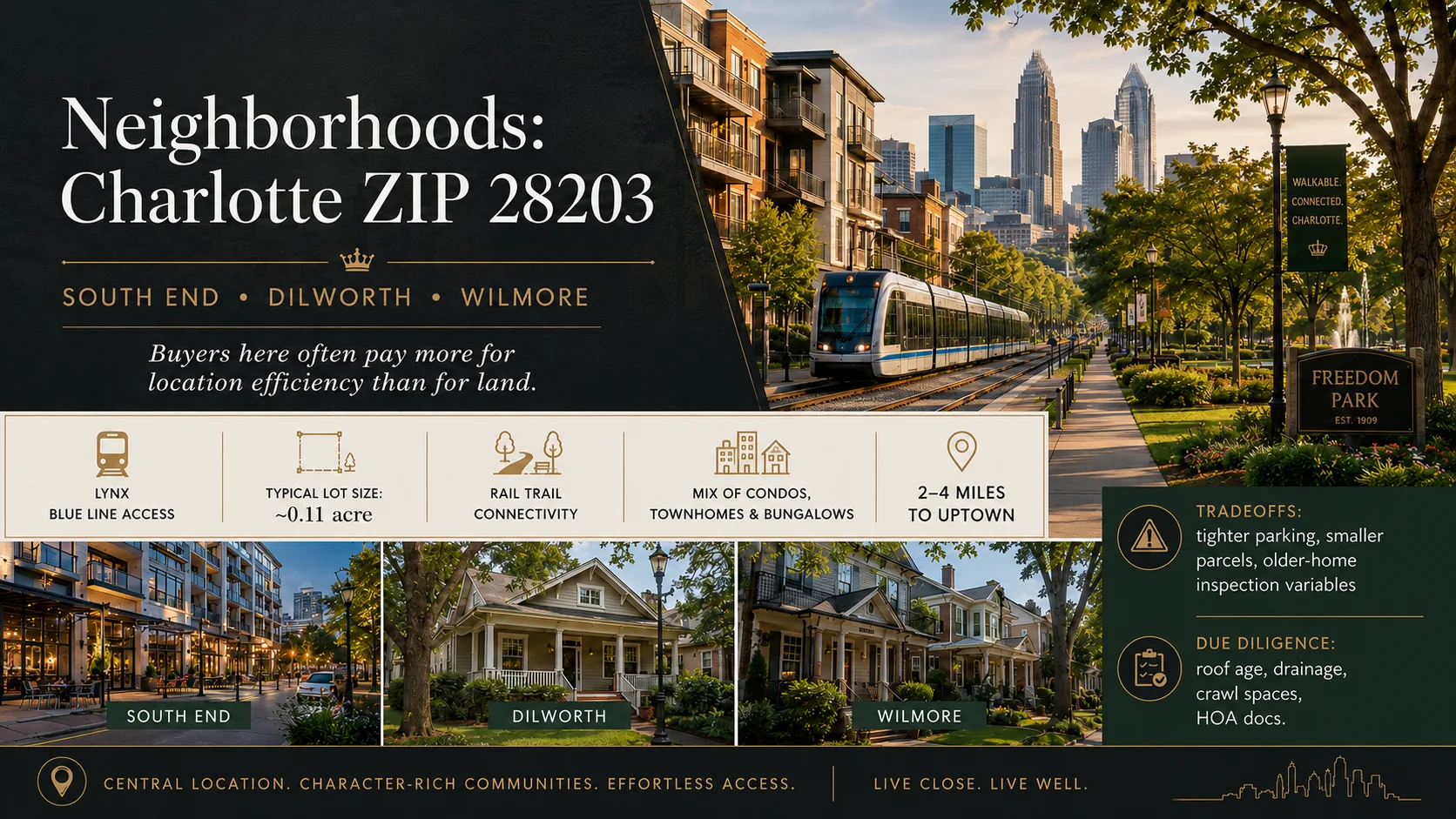
Key Neighborhoods Around Matthews, NC
Sardis Forest
Sardis Forest is a mature, tree-lined neighborhood known for its established homes and family-friendly atmosphere. Most houses here are single-family, built in the late 1970s through the 1990s, with median sale prices $480,000. The average lot size is 0.33 acres, giving residents more outdoor space than many newer developments. Sardis Forest is popular with move-up buyers and families seeking access to Elizabeth Lane Elementary and the Four Mile Creek Greenway.
Brightmoor
Brightmoor offers a classic suburban setting with a mix of two-story traditional and ranch-style homes. Median prices typically hover near $430,000, making it a bit more accessible for first-time buyers or those looking for value. Lots average 0.25 acres. Residents enjoy neighborhood amenities like two community pools, tennis courts, and easy access to Squirrel Lake Park.
Matthews Estates
Matthews Estates is a smaller, established neighborhood with a quiet, residential feel. Homes here are mostly brick ranches and split-levels, often on larger lots—median lot size is 0.40 acres. Median sale prices are $515,000. Matthews Estates appeals to buyers who want more space and privacy, with a strong owner-occupancy rate and proximity to downtown Matthews shops and the Matthews Community Center.
St. Andrews
St. Andrews is a newer development compared to others in the area, featuring mostly two-story homes built since the early 2000s. Median sale prices are $545,000, with average lot sizes near 0.18 acres. The neighborhood is attractive to families seeking newer construction and modern layouts, with quick access to Purser-Hulsey Park and the Brace Family YMCA.
Side-by-Side Numbers by Neighborhood
| Neighborhood | Median Sale Price | Median Lot Size |
|---|---|---|
| Sardis Forest | $480,000 | 0.33 acre |
| Brightmoor | $430,000 | 0.25 acre |
| Matthews Estates | $515,000 | 0.40 acre |
| St. Andrews | $545,000 | 0.18 acre |
| Neighborhood | Average Days on Market | Months of Inventory |
|---|---|---|
| Sardis Forest | 17 days | 1.2 |
| Brightmoor | 13 days | 1.0 |
| Matthews Estates | 19 days | 1.3 |
| St. Andrews | 15 days | 1.1 |
| Neighborhood | Owner-Occupancy % | Rental % | Short-Term Rental % |
|---|---|---|---|
| Sardis Forest | 86% | 14% | 2% |
| Brightmoor | 82% | 18% | 3% |
| Matthews Estates | 91% | 9% | 1% |
| St. Andrews | 78% | 22% | 4% |
| Neighborhood | Median Price | Price per Sq Ft | Median Lot Size | Average Days on Market | Months of Inventory | Owner-Occupancy % | Rental % | Short-Term Rental % |
|---|---|---|---|---|---|---|---|---|
| Sardis Forest | $480,000 | $220 | 0.33 acre | 17 | 1.2 | 86% | 14% | 2% |
| Brightmoor | $430,000 | $205 | 0.25 acre | 13 | 1.0 | 82% | 18% | 3% |
| Matthews Estates | $515,000 | $230 | 0.40 acre | 19 | 1.3 | 91% | 9% | 1% |
| St. Andrews | $545,000 | $240 | 0.18 acre | 15 | 1.1 | 78% | 22% | 4% |
How These Neighborhoods Compare for Different Buyers
St. Andrews stands out as the highest-priced option, with a median sale price of $545,000 and newer construction, making it attractive for buyers seeking modern layouts and finishes. Matthews Estates also trends higher in price, but offers the largest median lot size at 0.40 acres, appealing to those who value space and privacy.
Brightmoor is the most affordable among these neighborhoods, with a median price of $430,000. It’s a strong fit for first-time buyers or those looking for neighborhood amenities like pools and tennis courts without stretching the budget.
Sardis Forest offers a balance, with mid-range pricing and larger-than-average lots (0.33 acres), plus a high owner-occupancy rate. It’s a favorite for families wanting established trees and access to greenways.
Homes in Brightmoor tend to move fastest, with an average of just 13 days on market, while Matthews Estates sees slightly longer market times. Inventory remains tight across all neighborhoods, with most areas showing just over one month of inventory—meaning buyers need to act quickly.
Owner-occupancy is strongest in Matthews Estates (91%), while St. Andrews has a higher share of rentals and short-term rentals, reflecting more investor activity and possibly more transient residents.
Quick Questions Buyers Ask About These Neighborhoods
Q: Is St. Andrews usually more expensive than Sardis Forest?
A: Yes, St. Andrews has a higher median sale price ($545,000) compared to Sardis Forest ($480,000), largely due to newer construction.
Q: Which neighborhood is best for first-time buyers?
A: Brightmoor is often the most accessible for first-time buyers, with the lowest median prices and good neighborhood amenities.
Q: Where do homes sell the fastest?
A: Homes in Brightmoor typically spend just 13 days on market, making it the fastest-moving neighborhood among these options.
Q: Which area has the largest lots?
A: Matthews Estates offers the largest median lot size at 0.40 acres, ideal for buyers seeking more outdoor space.
Q: Where are there more long-term residents versus investors?
A: Matthews Estates and Sardis Forest both have high owner-occupancy rates (91% and 86% respectively), while St. Andrews has a higher rental and short-term rental presence.
Important Information, Independent Verification & No-Advice Disclaimer
Information on this website is provided solely for general informational and educational purposes as an overview of housing and real estate markets. Content is compiled, aggregated, correlated, and summarized from multiple online and third-party sources and may include automated or AI-assisted content. Information may be inaccurate, incomplete, outdated, or inconsistent.
To the fullest extent permitted by applicable law, information is provided “as is” and “as available,” without express or implied representations or warranties regarding accuracy, completeness, timeliness, reliability, or suitability for any particular purpose. Prices, availability, statistics, estimates, and projections may change without notice. No property value, appreciation, income, investment return, or other financial result is guaranteed.
This website does not provide personalized financial, investment, legal, tax, lending, or appraisal advice. Helen Harp Realty is not a financial-planning or investment-advisory firm, and its general website content is not a recommendation that any particular property, transaction, or strategy is suitable for you.
Do not rely on this website as the sole basis for a purchase, sale, financing, or investment decision. Before acting, independently verify all material information with multiple reliable sources, including applicable government agencies and official records, and the relevant property owner, listing broker, homeowners’ association, lender, insurer, or service provider. Confirm matters such as property condition, square footage, taxes, zoning, permitted uses, school assignments, fees, assessments, insurance, financing, and current availability. Consult appropriately licensed professionals regarding your circumstances.
Merely accessing this website or reading its content does not establish a brokerage, agency, advisory, or fiduciary relationship. Any separately established brokerage or agency relationship remains governed by applicable law and the parties’ agreements.
To the fullest extent permitted by applicable law, Helen Harp Realty and the website’s operators disclaim liability for losses arising from errors, omissions, or reliance on general website information. Nothing in this disclaimer limits duties owed under an established brokerage or agency relationship, excuses misrepresentation or failure to disclose material facts, or waives any right, duty, or liability that cannot lawfully be waived.
3Affordability
Affordability
How a dedicated workspace changes daily life in a North Carolina home
For buyers who work from home full time or even 2 to 3 days a week, a true office should be evaluated differently than a spare bedroom with a desk. During showings, look for a room that can hold at least a 5-foot desk, a chair with clearance behind it, storage, and video-call lighting without forcing the workspace into a main traffic path. In many NC floor plans, the best office locations are near the front entry, above a garage, in a finished bonus room, or separated from the kitchen and family room by at least one doorway; that separation matters if two adults are working, children are home after school, or clients are visiting.
Functionality also depends on noise, privacy, and layout. Buyers should stand in the proposed office with doors closed while someone walks through the kitchen, laundry area, and upstairs hallway to test sound transfer, especially in open-concept homes built in the last 10 to 15 years. If the room will double as a guest room, measure for a sleeper sofa or queen bed and confirm whether the closet, window size, and septic permit bedroom count align with county records and MLS remarks.
Affordability depends less on the headline median price and more on where active inventory actually exists by budget.
Homes by Price Range
$300–500K has the highest displayed value, 193 homes; $1.5M+ has the lowest, 22 homes. The gap is 171 homes.
Active IDX Broker / Canopy MLS inventory · Cached listing observations Jul 10, 2026–Oct 24, 2026
What Your Budget Buys
Single-Family has the highest displayed value, $575,000; Townhome has the lowest, $359,999. The gap is $215,001.
Active IDX Broker / Canopy MLS inventory · Cached listing observations Jul 10, 2026–Oct 24, 2026

What to verify before treating an office as a real work-from-home asset
Internet and utility practicality should be checked before an offer, not after closing. Ask which providers serve the address, whether fiber, cable, or fixed wireless is available, and what typical download/upload speeds are; for video-heavy work, many buyers prefer at least 100 Mbps down and 10 to 20 Mbps up, with higher capacity if multiple people stream or meet online at once. Also check outlet placement, HVAC reach, cell reception, and whether the electrical panel has capacity for added circuits, printers, monitors, or future built-ins.
Because buyer demand for flexible workspace remains strong, compare listing descriptions carefully rather than relying only on photos labeled “office.” MLS data, builder floor plans, county permits, and appraisal field notes can help distinguish a true study, a loft, a formal dining room conversion, and a finished bonus space. The best fit is usually a room that protects privacy, supports technology, and still preserves bedroom count and resale flexibility for the next buyer.
How a dedicated workspace changes daily life in a North Carolina home
For buyers who work from home full time or even 2 to 3 days a week, a true office should be evaluated differently than a spare bedroom with a desk. During showings, look for a room that can hold at least a 5-foot desk, a chair with clearance behind it, storage, and video-call lighting without forcing the workspace into a main traffic path. In many NC floor plans, the best office locations are near the front entry, above a garage, in a finished bonus room, or separated from the kitchen and family room by at least one doorway; that separation matters if two adults are working, children are home after school, or clients are visiting.
Functionality also depends on noise, privacy, and layout. Buyers should stand in the proposed office with doors closed while someone walks through the kitchen, laundry area, and upstairs hallway to test sound transfer, especially in open-concept homes built in the last 10 to 15 years. If the room will double as a guest room, measure for a sleeper sofa or queen bed and confirm whether the closet, window size, and septic permit bedroom count align with county records and MLS remarks.
What to verify before treating an office as a real work-from-home asset
Internet and utility practicality should be checked before an offer, not after closing. Ask which providers serve the address, whether fiber, cable, or fixed wireless is available, and what typical download/upload speeds are; for video-heavy work, many buyers prefer at least 100 Mbps down and 10 to 20 Mbps up, with higher capacity if multiple people stream or meet online at once. Also check outlet placement, HVAC reach, cell reception, and whether the electrical panel has capacity for added circuits, printers, monitors, or future built-ins.
Because buyer demand for flexible workspace remains strong, compare listing descriptions carefully rather than relying only on photos labeled “office.” MLS data, builder floor plans, county permits, and appraisal field notes can help distinguish a true study, a loft, a formal dining room conversion, and a finished bonus space. The best fit is usually a room that protects privacy, supports technology, and still preserves bedroom count and resale flexibility for the next buyer.
Cost of Living and Home Affordability in Matthews, NC
Understanding what it truly costs to buy a house in Matthews, NC, is essential for any prospective homebuyer. This section breaks down how household income translates into home price ranges, monthly payments, and overall affordability in the Matthews area.
We'll connect real-world income brackets to realistic home price targets, show a detailed monthly cost breakdown, and compare renting versus buying so you can make informed decisions about your next move.
What Different Incomes Can Buy in Matthews, NC
Your household income is the starting point for determining how much home you can afford. Lenders typically recommend spending no more than 28–31% of gross income on housing costs, including mortgage, taxes, and insurance.
For example, a household earning $55,000 per year can usually afford a home priced between $200,000 and $250,000, which often means looking at older homes or condos in Matthews or nearby areas. Meanwhile, a household with $100,000 in income may target homes in the $350,000–$400,000 range, opening up more options in established neighborhoods.
| Household Income Range | Typical Home Price Range | Approx. Monthly Housing Budget | Typical Buying Areas |
|---|---|---|---|
| $40,000–$60,000 | $180,000–$250,000 | $1,200–$1,600 | Older condos, small townhomes, outskirts of Matthews |
| $60,000–$80,000 | $230,000–$320,000 | $1,500–$1,900 | Entry-level single-family homes, some established neighborhoods |
| $80,000–$120,000 | $300,000–$450,000 | $2,000–$2,600 | Popular subdivisions, newer townhomes, central Matthews |
| $120,000–$180,000 | $400,000–$650,000 | $2,800–$3,700 | Larger homes, top-rated school zones, newer developments |
| $180,000–$300,000 | $600,000–$950,000 | $4,000–$5,700 | Luxury homes, custom builds, golf course communities |
| $300,000+ | $950,000+ | $6,000+ | Estate properties, gated communities, premium lots |
Breaking Down a Typical Monthly Payment
Let’s look at a representative example: a $375,000 home in Matthews, NC, which is a common price point for many buyers. With a 10% down payment and a 6.5% fixed mortgage rate, the total monthly payment includes principal and interest, property taxes, homeowner’s insurance, possible HOA dues, and utilities.
For this scenario, the total monthly housing cost typically falls between $2,200 and $2,600. The payment breakdown graphic (to be added) will reflect the following estimates:
| Component | Approx. Monthly Cost | Share of Total Payment |
|---|---|---|
| Principal & Interest | $2,130 | ~82% |
| Property Taxes | $270 | ~10% |
| Homeowner's Insurance | $90 | ~3% |
| HOA Dues (if applicable) | $50 | ~2% |
| Utilities | $200 | ~8% |
Renting vs Buying in Matthews, NC
Many buyers weigh the cost of renting versus owning. In Matthews, a typical 3-bedroom rental may cost $2,000 per month, while owning a similar home (including mortgage, taxes, and insurance) may run $2,400–$2,600 monthly.
While renting can be less expensive upfront, buying often becomes more cost-effective over time—especially as rents rise and homeowners build equity. In Matthews, the breakeven point where buying pulls ahead financially is usually between 4 and 6 years, depending on appreciation and maintenance costs.
| Scenario | Monthly Rent | Monthly Ownership Cost | Approx. Breakeven Horizon (Years) |
|---|---|---|---|
| 2-bedroom apartment | $1,600–$1,700 | $1,800–$2,000 | 5 |
| 3-bedroom single-family home | $2,000 | $2,400 | 4–5 |
| Newer 4-bedroom home | $2,500–$2,700 | $2,900–$3,100 | 6 |
What These Numbers Mean for Different Buyers
For lower-income buyers (earning $40,000–$60,000), options in Matthews typically include older condos or small townhomes, with monthly payments in the $1,200–$1,600 range. These buyers may need to compromise on size or location, or consider homes just outside the city center.
Mid-income buyers ($80,000–$120,000) have access to a wider selection, including newer townhomes and single-family homes in established neighborhoods. With monthly budgets of $2,000–$2,600, these buyers can often find homes in central Matthews or in top-rated school zones.
Higher-income households ($180,000+) can target luxury properties, larger lots, and custom builds, with monthly housing budgets exceeding $4,000. These buyers have the flexibility to prioritize features, location, and amenities.
Keep in mind, choosing a home farther from the center of Matthews or in neighboring towns can stretch your budget further, but may add to commute times and reduce walkability.
Quick Affordability Questions Buyers Ask in Matthews, NC
Q: Can a household earning around $70,000 still buy in Matthews?
A: Yes, but options may be limited to condos, townhomes, or smaller single-family homes priced up to $320,000, with monthly payments in the $1,500–$1,900 range.
Q: What down payment is typical for buyers here?
A: Many buyers put down 5–10%, though 20% can help avoid mortgage insurance and reduce monthly payments.
Q: How much monthly payment feels comfortable for most buyers?
A: Most buyers aim to keep total housing costs under 30% of gross income, which for a $100,000 household means a payment around $2,500 per month.
Q: Is it cheaper to rent or buy in Matthews right now?
A: Renting is often slightly cheaper in the first few years, but buying typically becomes more cost-effective after 4–6 years due to equity growth and rising rents.
Q: Are there affordable neighborhoods for first-time buyers?
A: Yes, areas with older homes or condos, especially on the outskirts of Matthews, can offer entry points for buyers with moderate incomes.
How a dedicated workspace changes daily life in a North Carolina home
For buyers who work from home full time or even 2 to 3 days a week, a true office should be evaluated differently than a spare bedroom with a desk. During showings, look for a room that can hold at least a 5-foot desk, a chair with clearance behind it, storage, and video-call lighting without forcing the workspace into a main traffic path. In many NC floor plans, the best office locations are near the front entry, above a garage, in a finished bonus room, or separated from the kitchen and family room by at least one doorway; that separation matters if two adults are working, children are home after school, or clients are visiting.
Functionality also depends on noise, privacy, and layout. Buyers should stand in the proposed office with doors closed while someone walks through the kitchen, laundry area, and upstairs hallway to test sound transfer, especially in open-concept homes built in the last 10 to 15 years. If the room will double as a guest room, measure for a sleeper sofa or queen bed and confirm whether the closet, window size, and septic permit bedroom count align with county records and MLS remarks.
What to verify before treating an office as a real work-from-home asset
Internet and utility practicality should be checked before an offer, not after closing. Ask which providers serve the address, whether fiber, cable, or fixed wireless is available, and what typical download/upload speeds are; for video-heavy work, many buyers prefer at least 100 Mbps down and 10 to 20 Mbps up, with higher capacity if multiple people stream or meet online at once. Also check outlet placement, HVAC reach, cell reception, and whether the electrical panel has capacity for added circuits, printers, monitors, or future built-ins.
Because buyer demand for flexible workspace remains strong, compare listing descriptions carefully rather than relying only on photos labeled “office.” MLS data, builder floor plans, county permits, and appraisal field notes can help distinguish a true study, a loft, a formal dining room conversion, and a finished bonus space. The best fit is usually a room that protects privacy, supports technology, and still preserves bedroom count and resale flexibility for the next buyer.
Important Information, Independent Verification & No-Advice Disclaimer
Information on this website is provided solely for general informational and educational purposes as an overview of housing and real estate markets. Content is compiled, aggregated, correlated, and summarized from multiple online and third-party sources and may include automated or AI-assisted content. Information may be inaccurate, incomplete, outdated, or inconsistent.
To the fullest extent permitted by applicable law, information is provided “as is” and “as available,” without express or implied representations or warranties regarding accuracy, completeness, timeliness, reliability, or suitability for any particular purpose. Prices, availability, statistics, estimates, and projections may change without notice. No property value, appreciation, income, investment return, or other financial result is guaranteed.
This website does not provide personalized financial, investment, legal, tax, lending, or appraisal advice. Helen Harp Realty is not a financial-planning or investment-advisory firm, and its general website content is not a recommendation that any particular property, transaction, or strategy is suitable for you.
Do not rely on this website as the sole basis for a purchase, sale, financing, or investment decision. Before acting, independently verify all material information with multiple reliable sources, including applicable government agencies and official records, and the relevant property owner, listing broker, homeowners’ association, lender, insurer, or service provider. Confirm matters such as property condition, square footage, taxes, zoning, permitted uses, school assignments, fees, assessments, insurance, financing, and current availability. Consult appropriately licensed professionals regarding your circumstances.
Merely accessing this website or reading its content does not establish a brokerage, agency, advisory, or fiduciary relationship. Any separately established brokerage or agency relationship remains governed by applicable law and the parties’ agreements.
To the fullest extent permitted by applicable law, Helen Harp Realty and the website’s operators disclaim liability for losses arising from errors, omissions, or reliance on general website information. Nothing in this disclaimer limits duties owed under an established brokerage or agency relationship, excuses misrepresentation or failure to disclose material facts, or waives any right, duty, or liability that cannot lawfully be waived.
4Schools
Schools
Schools and Home Values in Matthews, NC
For many families looking to buy a house in Matthews NC, , school quality is a top priority. The reputation and performance of local schools often shape where buyers focus their search and how much they are willing to pay for a home.
This section explores how schools in and around Matthews influence home values, demand, and neighborhood stability—key factors for anyone considering a move to this area.
School choice can shape a home search, but availability still depends on what is actually listed in each school-area grouping right now.
School-Area Inventory
William Amos Hough has the highest displayed value, 256 homes; West Charlotte has the lowest, 138 homes. The gap is 118 homes.
Canopy MLS high-school field · Cached listing observations Jul 10, 2026–Oct 24, 2026
Family Budget Reach
Share of school-area listings under $500,000.
$500K
29% of these school-area listings are under $500,000; 71% are $500,000 or more. More of the listed selection falls at or above this threshold.
Active IDX Broker / Canopy MLS inventory · Cached listing observations Jul 10, 2026–Oct 24, 2026
Typical Price by School Area
Myers Park has the highest displayed value, $2,239,000; Hopewell has the lowest, $549,900. The gap is $1,689,100.
Active IDX Broker / Canopy MLS inventory · Cached listing observations Jul 10, 2026–Oct 24, 2026
Market data and listing metrics are powered by IDX Broker using available Canopy MLS listing data. School-area groupings are provided for real estate inventory context only and are not school assignment guarantees. Buyers should verify school assignments with the appropriate school district before making purchase decisions.

Elementary Schools That Shape Neighborhood Demand
At Elizabeth Lane Elementary, families are drawn by its strong academic reputation and community involvement. Rated in the high 8-to-9 range by several school rating sites, this school serves established neighborhoods with mature trees and a mix of classic and updated homes. Homes in this zone often attract multiple offers and sell quickly, especially in spring and summer.
Crown Point Elementary serves a diverse area that includes both older Matthews neighborhoods and newer subdivisions. With a solid reputation for student growth and supportive staff, Crown Point attracts steady interest from buyers seeking both value and quality. Prices here are competitive, but sometimes slightly more accessible than in the highest-demand zones.
Matthews Elementary is known for its welcoming environment and active PTA. It serves a mix of in-town Matthews and adjacent neighborhoods. Demand near Matthews Elementary is consistently strong, with homes tending to sell above list price when inventory is low.
Middle School Zones and Move-Up Buyers
Crestdale Middle School is one of the most frequently mentioned middle schools in Matthews. It draws students from several sought-after elementary zones and is recognized for a well-rounded curriculum, including STEM and arts electives. The school’s reputation helps drive demand among move-up buyers looking for larger homes and stable neighborhoods.
Mint Hill Middle School serves parts of the Matthews area as well, offering a range of academic and extracurricular programs. While performance ratings are solid, buyers often compare it with Crestdale when weighing their options. Homes in these zones tend to hold value well, especially among families planning for high school transitions.
High Schools and Long-Term Value
Providence High School is widely regarded as one of the top public high schools in the region, with graduation rates typically in the 90%+ range and a robust selection of AP and honors courses. The school’s strong academic reputation and athletics programs create a noticeable premium for homes in its zone—buyers are often willing to stretch their budgets to secure a spot here, and listings tend to move quickly.
Butler High School serves much of Matthews and is known for its diverse student body, strong arts programs, and competitive athletics. While its ratings are generally solid, the school is especially valued for its inclusive environment and range of extracurriculars. Homes in the Butler zone are popular with buyers seeking a balance of value and opportunity, and the area sees steady demand year-round.
East Mecklenburg High School also serves portions of Matthews. It offers the International Baccalaureate (IB) program and a variety of career pathways. The presence of specialized programs attracts buyers looking for academic options beyond the standard curriculum, and homes near East Meck often appeal to families prioritizing these offerings.
Comparing Key Schools That Buyers Ask About
| School | Level | Approx. Rating or Performance Band | Notable Programs or Features | Impact on Nearby Home Prices |
|---|---|---|---|---|
| Elizabeth Lane Elementary | Elementary | Rated 8–9/10 | Strong academics, active PTA | Strong premium—homes sell quickly |
| Crestdale Middle School | Middle | Rated in the 7–8/10 range | STEM, arts electives | Moderate to strong premium |
| Providence High School | High | Rated 8–9/10; grad rate 90%+ | AP courses, athletics | Strong premium—high demand |
| Butler High School | High | Rated in the 7–8/10 range | Arts, athletics, inclusive environment | Moderate premium |
| East Mecklenburg High School | High | Rated in the 6–7/10 range | IB program, career pathways | Mild to moderate premium |
How to Read School Data When You Are Buying
Homes in top-rated school zones in Matthews, NC, often command higher prices and attract more competition, especially during peak buying seasons. As the rating bars above show, even a one-point difference in school ratings can translate to thousands of dollars in list price or days on market.
It’s important to remember that school boundaries can change. Always verify current assignments with Charlotte-Mecklenburg Schools before making an offer, as boundary shifts can affect both school access and resale value.
“Good fit” means more than test scores—consider programs, commute times, extracurriculars, and your family’s unique needs. For some buyers, a slightly lower-rated school with a specialized program or a shorter commute may be the best choice.
Balance your school priorities with your overall budget and the type of neighborhood you want. In Matthews, there are options for a range of needs, but the most in-demand zones do see the fiercest competition.
Quick School Questions Buyers Ask in Matthews
Q: Do homes in top-rated school zones always cost more in Matthews?
A: Generally, yes—homes near highly rated schools like Elizabeth Lane Elementary and Providence High tend to sell for a noticeable premium, and often move faster than comparable homes outside those zones.
Q: Is it possible to buy into a good school zone on a moderate budget?
A: It can be challenging, but not impossible. Focusing on solid but slightly less competitive schools, or looking at homes that need cosmetic updates, can help buyers stay within budget while still accessing quality education.
Q: How far ahead should we plan if we have young children?
A: Many buyers in Matthews plan several years ahead, especially if they want to stay in the same feeder pattern from elementary through high school. Early planning gives you more options and less stress as your family grows.
Q: Can we change schools later without moving?
A: Some families pursue magnet or charter school options, but for most public schools in Matthews, your address determines your assignment. Changing schools usually means moving to a new zone.
School Data Sources and References
School-related summaries in this section are based on patterns commonly reported by:
- GreatSchools and Niche school rating sites
- Charlotte-Mecklenburg Schools district report cards and state education data
- Local MLS remarks, relocation guides, and agent market experience
Important Information, Independent Verification & No-Advice Disclaimer
Information on this website is provided solely for general informational and educational purposes as an overview of housing and real estate markets. Content is compiled, aggregated, correlated, and summarized from multiple online and third-party sources and may include automated or AI-assisted content. Information may be inaccurate, incomplete, outdated, or inconsistent.
To the fullest extent permitted by applicable law, information is provided “as is” and “as available,” without express or implied representations or warranties regarding accuracy, completeness, timeliness, reliability, or suitability for any particular purpose. Prices, availability, statistics, estimates, and projections may change without notice. No property value, appreciation, income, investment return, or other financial result is guaranteed.
This website does not provide personalized financial, investment, legal, tax, lending, or appraisal advice. Helen Harp Realty is not a financial-planning or investment-advisory firm, and its general website content is not a recommendation that any particular property, transaction, or strategy is suitable for you.
Do not rely on this website as the sole basis for a purchase, sale, financing, or investment decision. Before acting, independently verify all material information with multiple reliable sources, including applicable government agencies and official records, and the relevant property owner, listing broker, homeowners’ association, lender, insurer, or service provider. Confirm matters such as property condition, square footage, taxes, zoning, permitted uses, school assignments, fees, assessments, insurance, financing, and current availability. Consult appropriately licensed professionals regarding your circumstances.
Merely accessing this website or reading its content does not establish a brokerage, agency, advisory, or fiduciary relationship. Any separately established brokerage or agency relationship remains governed by applicable law and the parties’ agreements.
To the fullest extent permitted by applicable law, Helen Harp Realty and the website’s operators disclaim liability for losses arising from errors, omissions, or reliance on general website information. Nothing in this disclaimer limits duties owed under an established brokerage or agency relationship, excuses misrepresentation or failure to disclose material facts, or waives any right, duty, or liability that cannot lawfully be waived.
5Market Outlook
Market Outlook
Where the Matthews, NC Housing Market Is Heading
This section brings together recent trends in home prices, inventory, and market speed to offer a forward-looking perspective for anyone considering whether to buy a house in Matthews NC, . We’ll examine what’s likely over the next few months, the coming couple of years, and the longer-term outlook, helping you understand the risks and opportunities at each stage.
Whether you’re a first-time buyer, move-up purchaser, or investor, understanding these time horizons can help you make a more informed decision about when and how to enter the Matthews housing market.
Read the Matthews outlook through three current signals: how much supply is available, how much pricing power sellers hold right now, and where that supply sits by price.
Current Inventory Baseline
Listed homes by property type.
Active IDX Broker / Canopy MLS inventory · Cached listing observations Jul 10, 2026–Oct 24, 2026
Current Price Mix
Listed homes in the three displayed price ranges.
Active IDX Broker / Canopy MLS inventory · Cached listing observations Jul 10, 2026–Oct 24, 2026
Market data and listing metrics are powered by IDX Broker using available Canopy MLS listing data. Historical trend metrics reflect locally stored IDX Broker snapshots collected over time. Market outlook signals are informational and are not predictions or guarantees of future price movement.

Short-Term Direction: Next 3–6 Months
In the near term, the Matthews housing market continues to show signs of modest upward price pressure, though the pace has cooled compared to the rapid gains seen in previous years. Inventory remains relatively tight, with new listings being absorbed quickly, especially in desirable neighborhoods.
Average days on market (DOM) are still low by historical standards, though homes are taking slightly longer to sell than during the peak of the recent seller’s market. Most properties are still selling close to asking price, but there is a slight uptick in price reductions, indicating that buyers have a bit more negotiating power than last year.
Overall, the short-term market in Matthews leans slightly toward sellers, but with more balance emerging. Buyers may find less competition than in 2021–2022, but should still be prepared for multiple-offer scenarios on well-priced homes.
Mid-Term Outlook: 12–24 Months
Looking out over the next one to two years, the Matthews market is expected to experience steady, moderate price appreciation. The area benefits from strong job growth in the Charlotte metro, continued in-migration, and a limited pipeline of new construction relative to demand.
Inventory is likely to remain below long-term averages, though some gradual loosening could occur if mortgage rates remain elevated or if more homeowners choose to list. Affordability may become a headwind for some buyers, especially if wage growth does not keep pace with home values.
The market is projected to remain balanced to slightly seller-leaning, with stable demand and no signs of significant oversupply. Buyers may see more choices and less urgency than in the recent past, but waiting for a major price drop is unlikely to pay off.
Long-Term Stability and Risk Profile
Over a three-year horizon and beyond, Matthews appears structurally strong. The area’s proximity to Charlotte, quality schools, and family-friendly amenities make it a perennial favorite for both local and relocating buyers.
The local economy is diversified, with employment opportunities in healthcare, finance, education, and technology supporting steady population growth. Demographic trends point to continued demand from both young families and downsizing retirees.
Long-term risks include the potential for overbuilding in certain segments, or a broader economic downturn that could impact demand. However, Matthews’ desirability and limited land for new development provide a buffer against severe price corrections.
Snapshot: Short-Term, Mid-Term, and Long-Term Signals
| Time Horizon | Price Trend | Inventory Trend | Competition Level | Buyer Takeaway |
|---|---|---|---|---|
| Next 3–6 Months | Modest upward pressure | Tight, but slowly improving | Still competitive, but easing | Act quickly on well-priced homes; some room to negotiate |
| Next 12–24 Months | Steady, moderate appreciation | Gradual increase possible | Balanced to slight seller advantage | More options, less urgency; unlikely to see major price drops |
| 3+ Years | Stable, long-term growth | Remains below historic average | Healthy, sustainable demand | Strong fundamentals support long-term value |
What This Market Outlook Means If You Are Buying
For buyers planning to purchase in Matthews in the next 3–6 months, expect a market that still favors sellers, but with more breathing room than in the recent past. Acting decisively on well-priced homes is important, but buyers may have more opportunities to negotiate or avoid bidding wars.
If you are considering waiting 12–24 months, you may find a slightly larger selection of homes and less intense competition. However, prices are likely to be higher, and waiting for a significant market correction is not supported by current fundamentals.
First-time buyers or those with specific needs (such as school zones or commute times) may benefit from acting sooner, while move-up buyers or investors with flexibility might wait for more inventory. However, the risk of being priced out over time remains if demand continues to outpace supply.
Ultimately, your personal timeline and financial readiness should guide your decision, but the Matthews market offers solid long-term value for those who plan to stay in their home for several years.
Quick Questions Buyers Ask About the Market in Matthews, NC
Q: Am I buying at the top if I purchase in Matthews right now?
A: While price growth has slowed, there is no clear sign of a market peak or imminent drop. Matthews’ fundamentals remain strong, supporting continued stability.
Q: Could prices drop in the next year?
A: A significant price drop is unlikely given ongoing demand and limited supply. Minor fluctuations are possible, but the risk of a sharp decline is low.
Q: Is it smarter to wait for rates to fall?
A: Waiting for lower rates could bring more buyers back into the market, increasing competition. If you find a home that fits your needs and budget now, locking in may be wise.
Q: How long should I plan to stay for buying to make sense in Matthews?
A: Generally, planning to stay at least 3–5 years helps offset transaction costs and benefit from long-term appreciation in Matthews.
Market Data Sources and References
Market patterns summarized in this section reflect trends commonly reported by:
- Canopy MLS and Charlotte Regional REALTOR® Association market reports
- Redfin, Zillow, and Realtor.com housing trend dashboards
- U.S. Census Bureau and regional economic development data
Important Information, Independent Verification & No-Advice Disclaimer
Information on this website is provided solely for general informational and educational purposes as an overview of housing and real estate markets. Content is compiled, aggregated, correlated, and summarized from multiple online and third-party sources and may include automated or AI-assisted content. Information may be inaccurate, incomplete, outdated, or inconsistent.
To the fullest extent permitted by applicable law, information is provided “as is” and “as available,” without express or implied representations or warranties regarding accuracy, completeness, timeliness, reliability, or suitability for any particular purpose. Prices, availability, statistics, estimates, and projections may change without notice. No property value, appreciation, income, investment return, or other financial result is guaranteed.
This website does not provide personalized financial, investment, legal, tax, lending, or appraisal advice. Helen Harp Realty is not a financial-planning or investment-advisory firm, and its general website content is not a recommendation that any particular property, transaction, or strategy is suitable for you.
Do not rely on this website as the sole basis for a purchase, sale, financing, or investment decision. Before acting, independently verify all material information with multiple reliable sources, including applicable government agencies and official records, and the relevant property owner, listing broker, homeowners’ association, lender, insurer, or service provider. Confirm matters such as property condition, square footage, taxes, zoning, permitted uses, school assignments, fees, assessments, insurance, financing, and current availability. Consult appropriately licensed professionals regarding your circumstances.
Merely accessing this website or reading its content does not establish a brokerage, agency, advisory, or fiduciary relationship. Any separately established brokerage or agency relationship remains governed by applicable law and the parties’ agreements.
To the fullest extent permitted by applicable law, Helen Harp Realty and the website’s operators disclaim liability for losses arising from errors, omissions, or reliance on general website information. Nothing in this disclaimer limits duties owed under an established brokerage or agency relationship, excuses misrepresentation or failure to disclose material facts, or waives any right, duty, or liability that cannot lawfully be waived.
6Buyer Strategy
Buyer Strategy
How to Play the Matthews, NC Housing Market as a Buyer
This section translates everything you’ve learned about Matthews, NC, into a practical, step-by-step game plan. Whether you’re a first-time buyer, moving up, or relocating for work, your approach will depend on your income, credit, and how quickly you need to move.
Matthews buyers face a range of realities: some are ready to compete right now, while others may need to shore up finances or wait for the right home to hit the market. The following strategies, profiles, and resources will help you make smart decisions every step of the way.
Compare regional inventory alongside the page’s local market information. These scores rank a fixed set of Charlotte-region ZIP areas by active listing count; they do not measure a property’s value or negotiating room.
Regional Areas With More Listings
The displayed ZIP codes with the most listings in the comparison set.
Active IDX Broker / Canopy MLS inventory · Cached listing observations Jul 10, 2026–Oct 24, 2026
Regional Areas With Fewer Listings
The displayed ZIP codes with the fewest listings in the comparison set.
Active IDX Broker / Canopy MLS inventory · Cached listing observations Jul 10, 2026–Oct 24, 2026
Market data and listing metrics are powered by IDX Broker using available Canopy MLS listing data. Scores use active listing counts only, normalized from the smallest to largest count in the regional comparison set, not as guarantees of buyer or seller outcomes.

We’ll cover how to prep your finances, what real buyers in Matthews look like, how to leverage local expertise, and what to expect when it’s time to move.
Getting Your Finances and Credit Ready
Your credit score, debt-to-income ratio, and cash reserves are the foundation of your buying power in Matthews. Stronger financial profiles open up better loan options, lower monthly payments, and more leverage in negotiations. Even small improvements to your credit or savings can make a noticeable difference in this market.
| Credit Band | General Strategy |
|---|---|
| 740+ | Focus on finding the right home and locking in strong terms. |
| 700–739 | Still strong; balance timing, savings, and rate shopping. |
| 660–699 | Watch PMI and total payment; consider mild credit improvements. |
| 620–659 | Often best to focus on cleaning up debt and building reserves. |
| Below 620 | Usually requires a longer-term rebuilding plan before buying. |
If you’re in the 740+ range, you can focus on finding the right home and negotiating confidently. Buyers in the 700–739 band still have strong options, but should pay close attention to timing and shop for the best terms. Those in the 660–699 range may want to weigh the benefits of a quick purchase versus taking a few months to improve credit and reduce PMI costs.
For buyers in the 620–659 range, it’s often wise to focus on debt reduction and building savings before jumping in. Below 620, most buyers will need to work on credit repair before qualifying for most loan programs. Every lender and loan program is different, so always consult a licensed mortgage professional for personalized advice.
Five Realistic Buyer Profiles in Matthews, NC
Profile 1: Grocery Store Department Manager in Matthews
This buyer works full-time as a department manager at a Matthews grocery store, earning $48,000–$55,000 per year. With a credit score in the 660–699 range, their best strategy is to focus on FHA or low down payment conventional loans, while watching their total monthly payment. They should shop for homes at the lower end of the Matthews market and consider improving credit slightly to reduce PMI costs.
Profile 2: Nurse at Novant Health Matthews Medical Center
A registered nurse at the local hospital, earning $70,000–$85,000 annually, with a credit score in the 700–739 band. This buyer is well-positioned to buy now, with access to a wide range of loan options. They can target homes in established neighborhoods and may be able to put down 5–10%. Their focus should be on balancing location, commute, and long-term value.
Profile 3: Public School Teacher in Matthews
This buyer teaches in the Charlotte-Mecklenburg Schools system, earning $52,000–$60,000 per year, with a credit score in the 620–659 range. Their best move is to work on paying down debt and increasing savings for a few months, possibly using down payment assistance programs. Touring homes is fine, but patience and credit improvement will expand their options and lower costs.
Profile 4: Logistics Analyst at a Charlotte Regional Firm
Employed by a logistics company in the greater Charlotte area, this mid-level professional earns $85,000–$100,000 per year and has a credit score above 740. They can move quickly, shop in the $400,000+ range, and negotiate strongly. Their strategy is to identify the best neighborhoods in Matthews for schools and resale value, and act decisively when the right home appears.
Profile 5: Remote Tech Worker Relocating for Matthews Lifestyle
This buyer works remotely for a national tech company, earning $110,000–$130,000 per year, with a credit score in the 700–739 range. They’re drawn to Matthews for its family-friendly vibe and access to Charlotte. With flexibility on timing and a healthy down payment, they can shop across several neighborhoods and focus on homes that fit their lifestyle, moving aggressively when a good fit is found.
Pre-Approval and Lender Strategy
Getting pre-approved is a crucial early step. A quick online pre-qualification gives you a rough idea of your price range, but a full pre-approval—where a lender reviews your documents—carries much more weight with sellers in Matthews.
Gather your recent pay stubs, W-2s or 1099s, and bank statements before applying. This preparation speeds up the process and helps you spot any issues early. When you’re ready, compare offers from a few lenders to see who provides the best terms for your situation, but don’t overcomplicate things by applying everywhere.
Remember, every lender has different requirements and programs. Rely on licensed mortgage professionals to guide you through the specifics, and never assume one lender’s answer is the final word.
Smart Search and Touring Strategy in Matthews, NC
Use what you’ve learned about Matthews’ neighborhoods, affordability, and schools to focus your search. Narrowing your options by area and price band will save you time and help you spot value quickly. Touring homes in clusters—by neighborhood or price—makes it easier to compare and decide.
In Matthews, homes can move quickly, especially in popular neighborhoods. Be ready to tour on short notice and make decisions promptly when you find a strong fit. Many buyers in Matthews choose to work with Helen Harp Realty for their local expertise and data-driven approach.
Helen Harp Realty combines deep knowledge of Matthews with real-time market data, helping buyers zero in on the best neighborhoods and avoid costly missteps. Their team guides you from first tour to closing, making the process as smooth as possible.
Work With Helen Harp Realty
Helen Harp Realty
Keller Williams Ballantyne
Ballantyne Corporate Place, Suite 500
Charlotte, NC
Phone: 704-957-4001
Website: www.HelenHarp-Realty.com
Local Moving Resources to Help You Land in Matthews, NC
- Home Depot Matthews – Truck rental available, 1837 Matthews Township Pkwy, Matthews, NC , Phone: 704-847-6611.
- U-Haul Moving & Storage of Matthews – Truck and trailer rentals, E Independence Blvd, Matthews, NC , Phone: 704-847-5477.
- All My Sons Moving & Storage – Local and long-distance moving services, Charlotte, NC, Phone: 704-344-1300.
- Gentle Giant Moving Company – Professional movers serving Matthews and the Charlotte area, Phone: 704-504-5151.
These resources represent the types of local support available to help you handle the logistics of moving in or out of Matthews. Always confirm current addresses, hours, and availability before booking, as details can change.
Whether you’re renting a truck for a DIY move or hiring professionals, Matthews offers a range of options to fit your needs and budget.
Putting It All Together for Your Situation
Compare your own situation to the buyer profiles above: consider your credit band, income range, and the neighborhoods that fit your lifestyle. Use the strategies outlined here, along with the data from earlier sections, to build a plan that’s realistic and tailored to your goals.
Remember, every buyer’s journey is unique. The key is to be honest about your readiness, stay flexible, and lean on local experts like Helen Harp Realty to guide you through the process.
Quick Strategy Questions Buyers Ask in Matthews, NC
Q: Should I fix my credit before touring homes in Matthews?
A: Often yes; even mild improvements can lower PMI and expand options.
Q: How many homes should I expect to tour before writing an offer?
A: Many buyers in Matthews tour several homes before focusing on a short list, but timing depends on budget and availability.
Q: Is it worth starting the process if my score is still in the low 600s?
A: It can be, as long as you work with a lender on a plan and stay realistic about timing and price.
Q: How quickly do homes sell in Matthews?
A: Well-priced homes in desirable neighborhoods can move fast, so be ready to act when you find a good fit.
Q: Can I buy with a small down payment in Matthews?
A: Yes, there are low down payment options, but you’ll want to budget for PMI and closing costs.
Important Information, Independent Verification & No-Advice Disclaimer
Information on this website is provided solely for general informational and educational purposes as an overview of housing and real estate markets. Content is compiled, aggregated, correlated, and summarized from multiple online and third-party sources and may include automated or AI-assisted content. Information may be inaccurate, incomplete, outdated, or inconsistent.
To the fullest extent permitted by applicable law, information is provided “as is” and “as available,” without express or implied representations or warranties regarding accuracy, completeness, timeliness, reliability, or suitability for any particular purpose. Prices, availability, statistics, estimates, and projections may change without notice. No property value, appreciation, income, investment return, or other financial result is guaranteed.
This website does not provide personalized financial, investment, legal, tax, lending, or appraisal advice. Helen Harp Realty is not a financial-planning or investment-advisory firm, and its general website content is not a recommendation that any particular property, transaction, or strategy is suitable for you.
Do not rely on this website as the sole basis for a purchase, sale, financing, or investment decision. Before acting, independently verify all material information with multiple reliable sources, including applicable government agencies and official records, and the relevant property owner, listing broker, homeowners’ association, lender, insurer, or service provider. Confirm matters such as property condition, square footage, taxes, zoning, permitted uses, school assignments, fees, assessments, insurance, financing, and current availability. Consult appropriately licensed professionals regarding your circumstances.
Merely accessing this website or reading its content does not establish a brokerage, agency, advisory, or fiduciary relationship. Any separately established brokerage or agency relationship remains governed by applicable law and the parties’ agreements.
To the fullest extent permitted by applicable law, Helen Harp Realty and the website’s operators disclaim liability for losses arising from errors, omissions, or reliance on general website information. Nothing in this disclaimer limits duties owed under an established brokerage or agency relationship, excuses misrepresentation or failure to disclose material facts, or waives any right, duty, or liability that cannot lawfully be waived.
7Recap
Market Recap
City Market Recap for Matthews, NC ()
This section brings together the essential data and trends for anyone looking to buy a house in Matthews, NC, . Here, you'll find a consolidated view of price points, neighborhood patterns, affordability signals, school impact, and the current market direction—all in one place.
Whether you’re a first-time buyer, moving up, or relocating for schools, this recap distills the most important facts and figures to help you make an informed decision in the Matthews real estate market.
Here is the bottom line for Matthews: the strongest signals from the data above, where the market currently leans, and the smartest next move for buyers and sellers.
Top Market Signals
Single-family share has the highest displayed value, 80%; Homes $750K and up has the lowest, 21%. The gap is 59 percentage points.
Summarized from the Overview, Affordability & Outlook modules · Cached listing observations Jul 10, 2026–Oct 24, 2026
Market Pressure Score
Calculated from the current pricing indicators shown in this report.
The calculated score is 5/100, using 50% of active listings with price cuts with no sold-price comparison available.
Best Next Move
Half of active listings have recorded price cuts: 50% of active listings. Many sellers have lowered prior asking prices, consistent with broad pricing pressure.
Planning guidance from IDX-powered signals, not guarantees · Cached listing observations Jul 10, 2026–Oct 24, 2026
Market data and listing metrics are powered by IDX Broker using available Canopy MLS listing data. Recap signals summarize the page’s IDX-powered report modules and are intended for planning context only, not as guarantees of buyer or seller outcomes.

Key City Housing Metrics at a Glance
The table below serves as your quick reference dashboard for Matthews, NC. Each metric reflects trends and insights discussed in earlier sections—covering prices, inventory, days on market, taxes, insurance, and income patterns relevant to buyers in .
| Metric | Value or Range | Why It Matters |
|---|---|---|
| Median Home Price | $450,000 | Shows the central price point for most buyers. |
| Typical Price Range for Most Homes | $350,000–$650,000 | Helps buyers set realistic expectations for budget. |
| Months of Supply | 1.5–2.5 months | Indicates whether Matthews leans toward buyers or sellers. |
| Average Days on Market | 15–25 days | Signals how quickly homes tend to sell. |
| List-to-Sale Price Relationship | 98%–102% | Shows whether buyers typically pay asking, over, or under. |
| Recent 12-Month Price Trend | +2% to +4% | Summarizes near-term market direction. |
| Approx. 5-Year Price Trend | +35% to +45% | Highlights longer-term appreciation patterns. |
| Approx. Median Household Income | $90,000–$105,000 | Helps buyers gauge income-to-price alignment. |
| Typical Property Tax Band | $3,000–$5,000/year | Shows how taxes will affect monthly costs. |
| Typical Homeowner’s Insurance Band | $900–$1,400/year | Provides a rough sense of risk and cost. |
Matthews, NC, is moderately priced for the Charlotte metro, offering a blend of affordability and strong demand. The market is relatively fast-moving, with homes selling quickly and inventory remaining tight, favoring sellers but with some signs of stabilization.
Price trends have been steadily positive over the past five years, with recent gains slowing but still outpacing inflation. For buyers, this means Matthews remains a solid investment, though competition can be intense for well-priced homes.
Affordability Snapshot by Income Level
This table summarizes how different household income levels translate into home buying power and likely neighborhood options in Matthews. It reflects the relationship between income, housing budget, and the types of homes and areas accessible to each group.
| Household Income Band | Typical Home Price Range | Approx. Monthly Housing Budget | Likely Area Types in Matthews |
|---|---|---|---|
| $60,000–$80,000 | $225,000–$320,000 | $1,500–$2,100 | Older condos, entry-level townhomes, select smaller homes in established neighborhoods |
| $80,000–$110,000 | $300,000–$400,000 | $2,000–$2,700 | Townhome communities, smaller single-family homes, some in-town neighborhoods |
| $110,000–$150,000 | $375,000–$525,000 | $2,600–$3,600 | Mid-sized homes in family neighborhoods, newer subdivisions, desirable school zones |
| $150,000–$200,000+ | $500,000–$700,000+ | $3,500–$5,000+ | Larger homes, new construction, luxury communities, top school zones |
Households earning below $80,000 face the most affordability pressure, with limited options primarily in older or smaller properties. These buyers may need to compromise on size, updates, or location to stay within budget.
The $80,000–$110,000 bracket opens up more choices, especially in townhome communities and some established neighborhoods, but competition remains strong. The $110,000–$150,000 range is where buyers see the most flexibility, accessing larger homes and more desirable areas, including those with top-rated schools.
Move-up and higher-income buyers ($150,000+) enjoy the broadest selection, including new construction and luxury homes. For first-time buyers, creative strategies—such as targeting townhomes or older single-family homes—can help secure a foothold in Matthews.
Schools and Their Impact on Local Prices
The following table highlights several key schools in Matthews, NC, and summarizes their general reputation and influence on local home demand. These are approximate and should be verified by buyers as boundaries and ratings can change.
| School | Level | Approx. Rating / Performance Band | Notable Programs or Reputation | Impact on Nearby Home Demand |
|---|---|---|---|---|
| Elizabeth Lane Elementary | Elementary | Above Average | Strong test scores, active parent community | Drives higher prices and faster sales nearby |
| Crestdale Middle | Middle | Above Average | STEM and arts programs, well-regarded faculty | Steady demand; supports mid-to-upper price bands |
| Butler High School | High | Above Average | AP courses, athletics, strong graduation rates | Consistently boosts demand for family homes |
| Matthews Elementary | Elementary | Average to Above Average | Community focus, diverse programs | Stable demand; moderate price impact |
Homes located within the attendance zones of higher-performing schools like Elizabeth Lane Elementary and Butler High consistently command premium prices and attract more competition. Buyers targeting these areas should expect to pay more and act quickly.
School boundaries can shift from year to year, so it’s essential for buyers to verify current assignments before making a purchase. Balancing school priorities with budget and commute needs is key—sometimes expanding your search radius or considering nearby “average” schools can unlock better value.
What All of This Means If You Are Buying in Matthews, NC
Matthews, NC, is currently a seller-leaning market, with low inventory and quick sales, but price growth has moderated, suggesting a more balanced environment than in recent years. Buyers should be prepared for competition, especially in popular neighborhoods and school zones.
For most buyers, planning to stay at least 4–6 years is advisable to offset transaction costs and benefit from long-term appreciation. Lower-income buyers may need to be flexible on property type or location, while higher-income buyers have expanded options and can focus on top-tier schools or amenities.
Acting sooner may make sense if you find a home that fits your needs and budget, as prices are unlikely to drop sharply in the near term. However, if your needs are flexible, waiting for seasonal slowdowns or new listings could yield more choices.
Overall, Matthews offers a strong mix of value, stability, and community appeal for a range of buyers, but success requires preparation and decisiveness.
Quick Questions Buyers Ask After Seeing the Data
Q: Is Matthews still a good place to buy if I am a first-time buyer?
A: Yes, but entry-level options are limited and competitive; targeting townhomes or older homes can help first-time buyers get started here.
Q: Could prices in Matthews drop in the next year?
A: While price growth has slowed, the market remains stable and demand is strong, making significant price drops unlikely in the short term.
Q: What if I am moving mainly for schools?
A: Focus on the top-rated zones like Elizabeth Lane Elementary or Butler High, but be prepared for higher prices and faster-moving listings.
Q: How fast do I need to act if I see a home I like?
A: Most homes sell within 2–3 weeks, and the best-priced homes can go under contract in days, so quick decision-making is important.
Q: Are property taxes and insurance high in Matthews?
A: Taxes and insurance are moderate for the region, but buyers should budget $3,000–$5,000/year for taxes and $900–$1,400/year for insurance depending on the property.
Important Information, Independent Verification & No-Advice Disclaimer
Information on this website is provided solely for general informational and educational purposes as an overview of housing and real estate markets. Content is compiled, aggregated, correlated, and summarized from multiple online and third-party sources and may include automated or AI-assisted content. Information may be inaccurate, incomplete, outdated, or inconsistent.
To the fullest extent permitted by applicable law, information is provided “as is” and “as available,” without express or implied representations or warranties regarding accuracy, completeness, timeliness, reliability, or suitability for any particular purpose. Prices, availability, statistics, estimates, and projections may change without notice. No property value, appreciation, income, investment return, or other financial result is guaranteed.
This website does not provide personalized financial, investment, legal, tax, lending, or appraisal advice. Helen Harp Realty is not a financial-planning or investment-advisory firm, and its general website content is not a recommendation that any particular property, transaction, or strategy is suitable for you.
Do not rely on this website as the sole basis for a purchase, sale, financing, or investment decision. Before acting, independently verify all material information with multiple reliable sources, including applicable government agencies and official records, and the relevant property owner, listing broker, homeowners’ association, lender, insurer, or service provider. Confirm matters such as property condition, square footage, taxes, zoning, permitted uses, school assignments, fees, assessments, insurance, financing, and current availability. Consult appropriately licensed professionals regarding your circumstances.
Merely accessing this website or reading its content does not establish a brokerage, agency, advisory, or fiduciary relationship. Any separately established brokerage or agency relationship remains governed by applicable law and the parties’ agreements.
To the fullest extent permitted by applicable law, Helen Harp Realty and the website’s operators disclaim liability for losses arising from errors, omissions, or reliance on general website information. Nothing in this disclaimer limits duties owed under an established brokerage or agency relationship, excuses misrepresentation or failure to disclose material facts, or waives any right, duty, or liability that cannot lawfully be waived.









