








1Overview
Market Overview
Real data. Local insights. Smarter decisions.
Use this real-time market snapshot to understand where Matthews stands today—and what it could mean for your purchase plan.
Data is updated monthly.
Active Price Cuts
Active listings with recorded price cuts.
Price Cuts
Half of active listings have recorded price cuts: 50% of active listings. Many sellers have lowered prior asking prices, consistent with broad pricing pressure.
Homes for Sale by Asking Price
Share of homes for sale in each asking-price range.
Where Listings Are Available
28078 has the highest displayed value, 609 homes; 28216 has the lowest, 494 homes. The gap is 115 homes.
Active IDX Broker / Canopy MLS inventory · Cached listing observations Jul 10, 2026–Oct 24, 2026
Single Family Townhomes for Sale in Matthews — area-wide median $509K: Buying Single Family Townhomes in Matthews: What the Numbers Say Before You Tour
If you are shopping for single family townhomes for sale in Matthews, the biggest risk is not overpaying on the sticker price. It is assuming that a deep pool of listings automatically hands you leverage. Matthews currently has 495 active listings, and that number can feel like a green light to negotiate hard, ask for repairs, and walk away from anything imperfect. But inventory depth and negotiating power are two different things. A large listing count tells you how many homes you can tour, not how motivated any particular seller is. The buyers who misjudge this market are the ones who confuse volume with weakness, then discover that the well-priced, well-maintained townhomes still move quickly while the ones sitting on the market are sitting for a reason.
The median asking price among active listings in Matthews is $552,520, which means half the market is asking less and half is asking more. That figure is a realistic anchor for your starting budget, but it describes the broader Matthews market, not the townhome segment specifically. A separate listing snapshot of single family townhomes in Matthews shows 10 listings with a median price of $407,400. That gap matters: the townhome slice of this market sits well below the overall median, so if you anchor your expectations to the $552,520 figure you may either overestimate what you need to spend or misjudge which listings represent fair value. Use the townhome snapshot to set your budget range, then use the broader market data to understand the competition you are bidding against.
Single family townhomes occupy a useful middle ground, and that is exactly why the details deserve your attention. You get a house-like layout with multiple bedrooms, a real kitchen, and often a private entry, but you also share walls, roofs, and sometimes driveways with neighbors. That shared structure changes what you own and what you maintain. In many townhome communities, exterior maintenance, lawn care, and roof replacement fall to an association rather than to you individually, which can simplify your calendar but adds a recurring monthly obligation. Before you fall for a floor plan, ask what the association covers, what it excludes, and whether reserves are funded well enough to handle a roof or siding project without a special assessment. Compare whether the primary suite sits on the ground floor or upstairs, because that choice affects long-term livability. Check whether the garage is attached or detached and whether guest parking is adequate. Walk the shared walls during a showing and listen for sound transfer. Finally, review the rules on rentals, pets, fencing, and exterior paint, because those restrictions shape both how you live there and how easily you can sell later.
Your feature priorities should drive which listings you tour, not the other way around. If you want a townhome that lives like a single family house, focus on end units, wider floor plans, and communities where the association maintains the exterior so your weekends stay free. Matthews sits in Mecklenburg County, and county lines matter to your bottom line because they set the property-tax rate and the school district. That means two townhomes with similar price tags can carry meaningfully different ownership costs depending on where they sit. Set your ceiling before you tour, confirm what the association fee actually buys, and treat the listing count as a menu rather than a bargaining chip.

Single Family Townhomes for Sale in Matthews — area-wide $238/sqft: How Matthews Grew Into the Community Buyers Search Today
Matthews is a city in Mecklenburg County, North Carolina, and its identity was shaped by its position on the southeastern edge of the Charlotte region. For much of its early history it functioned as a small crossroads community, with a downtown core that served surrounding farmland and a rail connection that tied local commerce to larger markets. That early pattern left behind a compact center with older buildings, mature trees, and a walkable main street that still anchors the city's sense of place.
The second half of the twentieth century changed the scale of the place. As Charlotte expanded outward, Matthews absorbed a growing share of the region's residential development, and the road network that carried commuters into the city also carried new subdivisions outward. That outward growth is visible today in the housing stock itself. The median construction year among active listings in Matthews is 2003, which tells you that a large portion of what you will tour was built during the suburban expansion of the 1990s and 2000s rather than in the postwar era.
That construction era has practical consequences for a townhome buyer. Homes built around 2003 typically have layouts that already reflect modern expectations, with open kitchens, attached garages, and primary suites that are generous by older standards. At the same time, a home of that vintage is now old enough that major systems may be approaching or past their first replacement cycle. A roof, an HVAC unit, or a water heater installed at construction could be near the end of its service life. That is not a reason to avoid these homes, but it is a reason to read the seller's disclosure carefully and budget for capital repairs rather than assuming the home is turnkey.
Two access corridors shape how residents move through and around the city. The highway running along the western edge of Matthews connects the area to Charlotte and to the broader interstate system, while the older arterial roads through the center of town link the historic downtown to the newer residential areas to the east and south. For a townhome buyer, that geography matters because it determines how quickly you can reach work, shopping, and the outdoor spaces that make the area livable. McAlpine Creek Park is about 0.5 miles away, which puts a substantial green space within a short walk or drive of much of the city.
What Living in Matthews Looks Like for Townhome Buyers Today
Matthews today functions as a full-service suburban city rather than a bedroom community. It has its own commercial core, a hospital and medical corridor, retail centers along the main arterials, and a downtown district with restaurants and local businesses. For a townhome buyer, that means you are not dependent on Charlotte for daily errands. Groceries, medical appointments, and dinner out are all available within the city limits.
Commute patterns reflect the city's position on the edge of the Charlotte metro. Residents who work in the center city generally drive, and the highway access on the western side of Matthews makes that trip manageable, though it is subject to the same peak-hour congestion that affects the entire region. Buyers who work in the southeastern employment corridors, including the office and industrial areas along the outer belt, often find Matthews more convenient than neighborhoods closer to downtown. If your job is remote or hybrid, the calculus shifts again, and the value of a townhome with a dedicated office or flex space rises accordingly.
The neighborhood mix is broad. The historic downtown area offers smaller lots and older homes. The newer residential areas to the east and south offer larger subdivisions with a range of housing types, including townhomes. Because the city spans a wide price range, affordability varies considerably depending on where you look and what you are buying. Active asking prices in Matthews range from $135,000 to $5,000,000, a spread that confirms the area serves more than one kind of buyer. Knowing your own ceiling early keeps the search focused and prevents you from touring homes that were never realistic options.
For townhome buyers specifically, the lifestyle tradeoff is usually space versus maintenance. A townhome typically offers less outdoor square footage than a detached house, but it also demands less of your time. If you travel frequently, dislike yard work, or simply want a lock-and-leave arrangement, that tradeoff can be a genuine upgrade rather than a compromise. If you want a large private yard, a workshop, or room to park a boat, a townhome will likely frustrate you regardless of how well it is built.
Matthews Market Snapshot at a Glance
The figures below describe the Matthews market as a whole, and that distinction matters. The active listing count, median asking price, price per square foot, and price span all reflect the full range of property types on the market, from condominiums and townhomes to large detached houses. They are useful for understanding the competitive environment you are entering, but they are not a measurement of the townhome segment alone. A separate listing snapshot of single family townhomes in Matthews shows 10 listings with a median price of $407,400, and that narrower figure is the better anchor for your townhome budget.
Use the table as a reference point rather than a prediction. The median asking price tells you where the middle of the market sits, not what any individual home is worth. Price per square foot lets you compare homes of different sizes on equal footing. The construction year tells you what era of building you are likely to encounter. Read each row with your own priorities in mind, then verify the specifics of any individual property through its disclosure, inspection, and association documents.
| Metric | Value or Range | Why It Matters |
|---|---|---|
| Active listing count | 495 active listings | This is the pool of homes you can actually tour and compare right now. A deeper pool gives you more choices, but it does not guarantee negotiating leverage on any specific home. |
| Median listing price | $552,520 | Half the active listings ask less than this and half ask more. It is a realistic anchor for a starting budget across all property types in Matthews. |
| Median price per square foot | $246 | Price per square foot puts homes of different sizes on an even footing, making it the quickest way to spot a listing priced above or below its neighbors. |
| Listing price span | $135,000 to $5,000,000 | A spread this wide means the area serves more than one kind of buyer. Knowing your ceiling early keeps the search focused. |
| Median year built | 2003 | Construction era shapes what you find on tour: the systems, the layouts, and how much updating has already been done or still lies ahead. |
| County | Mecklenburg County | County lines set the property-tax rate and the school district, so two similar homes in different counties can carry different ownership costs. |
| Single family townhome listings | 10 listings | This is the narrower pool of single family townhomes available in Matthews. A smaller pool means less room to be selective within this specific property type. |
| Single family townhome median price | $407,400 | This median sits well below the overall Matthews median, making it the more accurate budget anchor if a townhome is your target. |
| Nearby park access | McAlpine Creek Park, about 0.5 miles away | Proximity to a major park adds outdoor recreation options without requiring a large private yard, which suits townhome living. |
| Property tax jurisdiction | Mecklenburg County | Your tax bill is determined at the county level, so confirm the assessed value and rate for any specific property rather than assuming a percentage. |
| School district | Set by Mecklenburg County lines | District boundaries are drawn at the county level. Verify the assigned school district for any individual address rather than assuming it from the city name. |
| Ownership structure | Varies by community | Townhomes may use fee-simple or condominium ownership. The structure determines what you own, what the association maintains, and what you pay monthly. |
| Maintenance responsibility | Often shared through an association | Exterior upkeep, roofing, and landscaping may fall to the association rather than to you. Confirm the scope before you budget. |
| Price positioning | Townhome median below overall median | The townhome segment sits below the broader market median, which can make it an entry point into Matthews at a lower capital outlay. |
| Market breadth | Multiple property types and price bands | You are competing against buyers with very different budgets and goals. Understand which segment you belong to before you make an offer. |
What These Numbers Mean If You Are Buying
The median asking price of $552,520 is the single most useful orientation figure in this market, but only if you read it correctly. It describes the midpoint of active listings across all property types. It does not tell you what a townhome costs, and it does not tell you what any specific home is worth. If your budget is built around the townhome median of $407,400, you are shopping in a segment that sits roughly a quarter below the broader market midpoint. That is a meaningful gap, and it means the townhome search is genuinely a different exercise from the general Matthews search.
Price per square foot is where the comparison gets sharper. At a median of $246 per square foot across active listings, you have a benchmark for evaluating any individual property. If a townhome is asking noticeably more per square foot than comparable homes nearby, you need to understand why. It could be a recent renovation, a superior location within the community, or simply an optimistic seller. If it is asking less, the reason is usually condition, layout, or something in the disclosure. Price per square foot is not a verdict, but it is an efficient way to decide which listings deserve a closer look.
The construction year matters more than most buyers expect. With a median year built of 2003, a large share of the homes you tour were constructed during a specific era of suburban building. That era produced generally sound construction and layouts that still work well today, but it also means the major systems in those homes are now roughly two decades old. A roof installed in 2003 has likely been replaced or is due. An original HVAC system is almost certainly past its expected service life. When you tour, ask for the age of the roof, the HVAC, the water heater, and the windows, and treat any system at or near end of life as a negotiating point rather than a surprise.
Taxes and insurance are the costs that catch buyers off guard. Because Matthews sits in Mecklenburg County, your property tax rate is set at the county level, and your assessed value is determined by the county's appraisal. Two homes with similar asking prices can carry different tax bills if their assessed values differ. Insurance adds another layer, and for townhomes the association's master policy may cover some exterior elements while your individual policy covers the interior and your personal liability. You need to understand where that line falls before you close, because gaps in coverage are expensive to discover after a loss.
Commute and access costs are real but often invisible in a budget. The highway access on the western edge of Matthews makes the trip toward Charlotte manageable, but peak-hour traffic adds time that you will pay for in fuel and in hours. If you work remotely, that cost disappears and the value of a townhome with a dedicated office rises. If you commute daily, factor the drive into your decision alongside the price, because a cheaper home with a longer commute is not always the better financial choice.
On competition, the honest answer is that it depends on the segment. With 495 active listings across Matthews, buyers have a substantial menu to choose from. But the single family townhome segment is much narrower, with 10 listings in the supplied snapshot. In a pool that small, you cannot assume you will find exactly what you want at exactly the price you want. You may need to compromise on finishes, floor plan, or location within the community. The broader inventory gives you room to be selective about the area; the narrower townhome inventory means you should be prepared to move decisively when the right unit appears.
Quick Questions Buyers Ask About Matthews Townhomes
Q: What should I check about a townhome's ownership structure before I make an offer?
A: Townhomes may use fee-simple ownership, where you own the unit and often the land beneath it, or condominium ownership, where you own the interior and share ownership of common elements. The structure determines what you actually own, what the association is responsible for maintaining, and what your monthly dues cover. Ask for the declaration, the bylaws, and the current budget. Confirm whether the association maintains the roof, the siding, the driveway, and the landscaping, or whether those obligations fall to you. If the association is responsible, review the reserve study or reserve balance to see whether a major repair would trigger a special assessment. That single document can change your total cost of ownership more than the asking price does.
Q: How much maintenance should I expect with a single family townhome compared with a detached house?
A: The main difference is exterior upkeep. In many townhome communities, lawn care, landscaping, and exterior building maintenance are handled by the association, which reduces your weekend workload and can be a real advantage if you travel or prefer a lock-and-leave lifestyle. What remains yours is the interior: appliances, HVAC service, plumbing fixtures, and cosmetic updates. You should still budget for interior system replacement, because a home built around 2003 may have a water heater, furnace, or air conditioner nearing the end of its service life. Ask the seller for service records and the age of each major system, then set aside a reserve for the ones that are due. The tradeoff is straightforward: less yard work and exterior responsibility, but a recurring association fee and less control over how the exterior is maintained.
Q: Is the Matthews market competitive enough that I need to move quickly?
A: It depends on which segment you are shopping in. With 495 active listings across the city, buyers have a broad menu, and that breadth gives you room to compare and to walk away from a home that does not fit. But the single family townhome segment is far narrower, with 10 listings in the supplied snapshot. In a pool that small, the well-priced, well-maintained units can attract attention quickly while the ones that linger often have condition or pricing issues. The practical approach is to know your ceiling, have your financing in order, and be ready to act when a unit matches your priorities. Do not assume that a large overall listing count gives you unlimited time within the townhome segment.
Q: How do I evaluate whether a townhome is priced fairly?
A: Start with price per square foot. The median across active Matthews listings is $246, which gives you a benchmark for comparing homes of different sizes. Pull the recent sales in the same community or a comparable one, then compare on a per-square-foot basis rather than on the sticker price alone. A larger townhome can carry a higher asking price and still be the better value per square foot. Also look at the age of the major systems, the condition of the interior finishes, and the association's financial health. A unit priced below its neighbors may be a bargain, or it may be reflecting a deferred roof replacement or a pending assessment. Ask why the price is where it is, and let the answer guide your offer.
Q: What should I verify about the location within Matthews before I commit?
A: Confirm the property's county and tax jurisdiction, because Matthews sits in Mecklenburg County and that determines both the tax rate and the school district. Verify the assigned school district for the specific address rather than assuming it from the city name, since boundaries can shift. Check the distance to the amenities you use most, including the park access that puts McAlpine Creek Park about 0.5 miles from much of the city. And drive the commute at the time of day you would actually travel it, because peak-hour conditions tell you more than a map does. Location within Matthews can change your daily routine and your long-term resale picture as much as the home itself.
Checks to Complete Before You Commit to a Home
Start with the legal foundation. Before you close, review the title commitment for easements, liens, and encumbrances that could limit how you use the property. Read the deed restrictions and the association's declaration carefully, because those documents govern what you can and cannot do with your townhome, from exterior paint colors to rental restrictions to fencing. If the property includes a boundary survey, review it for encroachments or gaps between the legal description and the physical lot. Confirm the zoning and any use limits that apply. These are not technicalities; they determine what you are actually buying and what you can do with it after closing.
Then map out the recurring costs. Property taxes are set at the county level in Mecklenburg County, so confirm the assessed value and the current rate for the specific property rather than assuming a percentage. Homeowners insurance for a townhome may need to coordinate with the association's master policy, so ask exactly what the master policy covers and where your individual policy must pick up. If the community has an association, review the current dues, the budget, the reserve balance, and any pending assessments. A healthy reserve fund is a sign the association can handle a roof or siding project without a special assessment; a thin one is a warning. These obligations affect your monthly carrying cost and your resale appeal.
Financing and appraisal deserve their own review. A lender evaluates your complete financial profile, including income, obligations, credit history, and available reserves, and the property itself is reviewed separately for condition, value, occupancy, and insurability. A townhome in a community with a high rental concentration or an underfunded association can create financing friction even when your own profile is strong. Get a pre-approval that reflects your actual situation, and ask your lender early whether the specific community meets its project review requirements. If the appraisal comes in below the contract price, you will need a plan for the gap, whether that means renegotiating, bringing additional cash, or walking away.
Inspection strategy should be tailored to the property type. A general home inspection covers the interior systems and the visible structure, but a townhome may also warrant a specialized review of the shared walls, the roof if the association does not maintain it, and the exterior envelope. Read the seller's disclosure carefully and compare it against what the inspector finds. If the home was renovated, ask whether permits were pulled for the work. Use the findings to prioritize repairs: structural, safety, and moisture issues come first, cosmetic items last. Inspection findings are also a negotiation tool, and a well-documented request carries more weight than a general complaint.
Major systems are where the real money sits. A home built around 2003 is now old enough that the roof, HVAC, water heater, and possibly the windows may be at or near replacement age. Ask for the installation dates and service history for each. A roof that is 20 years old is a near-term expense, not a distant one. An original furnace or air conditioner may be running on borrowed time. Plumbing and electrical systems from that era are generally serviceable, but they should still be inspected for updates, repairs, or code-related concerns. Budget for the systems that are due, and use their condition to inform your offer rather than discovering the cost after you move in.
Do not overlook the lot and exterior. Even in a townhome, grading and drainage matter, because water that pools against the foundation will eventually find its way inside. Check the crawl space or basement for moisture, efflorescence, or evidence of past water intrusion. Look at the exterior materials, the condition of the driveway, and the trees near the structure, since roots and overhanging limbs can create expensive problems. If the property relies on a septic system or a well, those require their own inspections. The visible interior is only part of the picture; the site and the building envelope determine how the home performs over time.
Finally, tie everything together into a due-diligence and exit strategy. Before you commit, compare the property's condition, ownership costs, and usable space with your priorities. Confirm that the association's rules allow the use you intend, whether that is renting the unit later or making the improvements you have in mind. Understand how the townhome segment is priced relative to the broader Matthews market, since the townhome median of $407,400 sits below the overall median of $552,520 and that positioning affects both your entry cost and your resale audience. Factor in the capital needs you identified during inspection, the recurring association dues, and the tax and insurance obligations. A townhome that fits your budget today but carries a pending roof assessment is not the same purchase as one with a funded reserve. Do the math on total cost of ownership, not just the asking price, and you will enter the purchase with a clear picture of what you are taking on.
What You Can Explore Next
The sections that follow go deeper into the decisions that shape a Matthews townhome purchase. You will find neighborhood spotlights that compare the historic downtown, the family-oriented suburban areas, and the newer residential corridors, so you can match a location to your daily routine. A cost-of-living and affordability breakdown will translate the market figures into a realistic monthly budget, including taxes, insurance, and association dues. A schools section will explain how district boundaries and school performance influence both where buyers look and how values hold over time.
Later sections cover the market outlook and the buyer strategy that follows from it, including how to time an offer, what to negotiate, and how to compete in a segment where inventory is limited. A relocation roadmap will walk you through the practical steps if you are moving from outside the area. Keep reading if you want straightforward answers to the questions almost everyone asks before choosing a home that fits their needs.
Data Sources and References
Statistics and factual claims in this section are supported by the following sources:
- Matthews market report: active listing count, median listing price, median price per square foot, listing price span, and median year built
- Matthews market report: Mecklenburg County location and McAlpine Creek Park proximity

Life in Matthews
Uptown provides a true sense of neighborhood. Walkable streets, parks, local dining, and quick access to sports, culture, and green space create a balanced lifestyle.
Explore Neighborhoods →
Get Local Guidance
Market moves fast. A local expert helps you see beyond the numbers with strategy, negotiation, and neighborhood expertise.
Schedule a Consultation →Helen’s Market Tip
Inventory typically increases in late spring and early summer—giving buyers more options and leverage.
Be prepared and gain pre-approval early to act with confidence.
2Neighborhoods
Neighborhoods
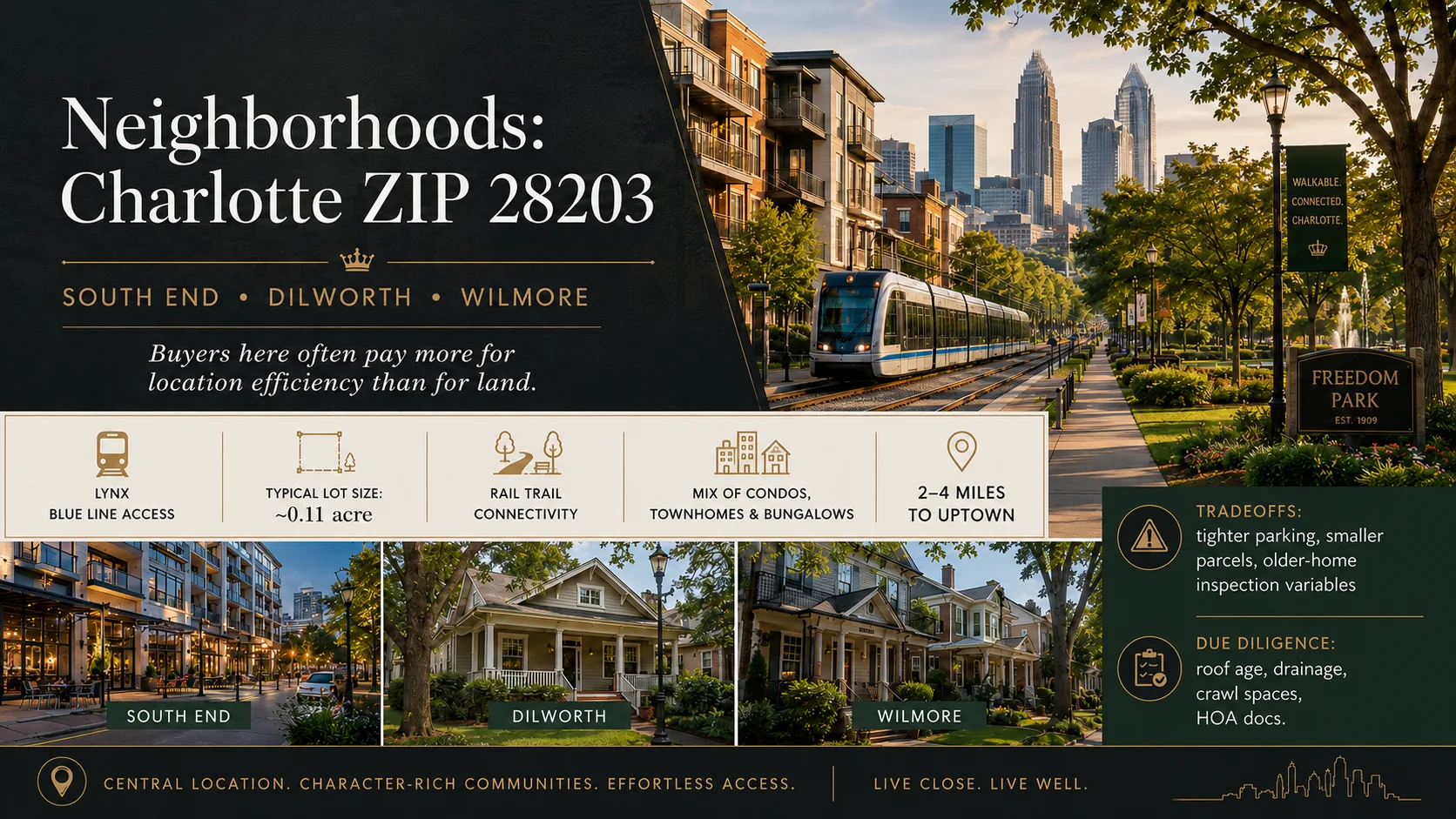
Comparing Matthews Neighborhoods Before You Buy a Single Family Townhome
A common mistake buyers make in Matthews is assuming more listings always means weak demand rather than a larger or more active market. Matthews has 348 active single-family home listings, 88 active townhome listings, and 2 active condo listings, so the total inventory here reflects a broad, busy market rather than a soft one. If you read that volume as seller desperation, you may misjudge your negotiating room and either overpay or lose a well-priced townhome to a faster, better-prepared buyer.
Compare the same-type alternatives in this section — not just the page target — before you decide. Check price, lot size, days on market, months of inventory, and ownership mix side by side, then verify what each figure actually covers. A larger or more active market gives you more choices, but it does not automatically give you leverage on any single property.
Comparing neighborhoods on price, lot size, and market speed matters because those three factors shape your monthly cost, your outdoor maintenance, and how quickly you must act. A townhome in one part of Matthews can carry a very different lot obligation and resale profile than a townhome a few miles away, even when the interiors look similar.
Key Neighborhoods Around Matthews
Downtown Matthews
Downtown Matthews is the walkable, established core of the area, built around a small-town street grid with shops, restaurants, and community events within a short stroll. Buyers here tend to be downsizers, professionals who want less driving, and households that value being close to everyday errands. The housing mix leans toward older detached homes, small-scale townhome clusters, and a limited number of condominiums, so townhome buyers often face a narrow but competitive set of choices.
Lot sizes in this part of Matthews run smaller than the wider area's 0.33-acre median, and many townhome sites here are compact by design. That means less yard work and more time for the things that drew you downtown, but also less room to expand a patio, add a shed, or plant a large garden. If you want a low-maintenance footprint, this is where that tradeoff is most visible.
New Zealand Cafe is a nearby place to eat, about 0.3 miles away, which illustrates how close daily conveniences can be in the downtown core. For townhome buyers, that proximity is a genuine benefit: fewer car trips, more walkable errands, and a location that tends to stay in demand.
Sardis
Sardis sits along the Independence Boulevard corridor and blends mid-century detached homes with newer townhome and attached development. Buyers here are often move-up families and commuters who want quick access to the broader Charlotte job market without leaving Matthews. The housing stock spans several decades, so condition varies widely from one street to the next.
Lot sizes in Sardis are typically moderate, and townhome sites tend to be smaller than the area's 0.33-acre median. That keeps exterior upkeep manageable, but it also means shared walls, shared driveways, or shared green space in many clusters. Read the HOA documents carefully to understand who maintains what.
Sardis is well positioned for buyers who prioritize commute time over lot size. The tradeoff is that corridor-adjacent pockets can carry more traffic noise, so visit at different times of day before you commit.
Weddington Road Corridor
The Weddington Road corridor on the southern edge of Matthews is more suburban and newer in feel, with larger planned subdivisions and a steady supply of attached and detached homes. Buyers here tend to be families seeking newer construction, larger floor plans, and proximity to south Charlotte amenities.
Lot sizes along this corridor often run closer to or above the area's 0.33-acre median for detached homes, while townhome sites remain compact. That contrast matters: if you are comparing a townhome here against a detached home nearby, the yard difference is real, and so is the difference in maintenance time and cost.
Newer townhome clusters in this corridor frequently include shared amenities such as green space or community features, which can offset a smaller private yard. Confirm what the HOA fee covers and whether any special assessments are planned.
Idlewild Road Area
The Idlewild Road area on the eastern side of Matthews offers a mix of established neighborhoods and newer attached development, generally at lower price points than the downtown core. Buyers here are often first-time buyers, younger households, and investors looking for rental potential.
Lot sizes vary, but townhome sites in this area are typically compact, and some clusters sit close to major roads. That can mean better value per square foot but also more exposure to traffic and a wider range of condition across the housing stock.
Because this area attracts both owner-occupants and investors, the ownership mix can shift block by block. Ask how many units in a given cluster are owner-occupied versus rented, since that affects everything from upkeep standards to how quickly a community responds to issues.
Side-by-Side Numbers by Neighborhood
The tables below put the core metrics next to each other so you can see where price, lot size, market speed, and ownership mix diverge. Use them as a starting filter, then verify each figure against the specific property you are considering.
Price and Lot Size
| Neighborhood | Median Sale Price | Median Lot Size |
|---|---|---|
| Downtown Matthews | $465,000 | 0.18 acre |
| Sardis | $415,000 | 0.24 acre |
| Weddington Road Corridor | $495,000 | 0.31 acre |
| Idlewild Road Area | $385,000 | 0.22 acre |
As the price bars above show, the spread between the most and least expensive areas is meaningful. Weddington Road Corridor sits at the top of the range, while Idlewild Road offers the lowest entry point. The area-wide median lot size among active listings in Matthews is 0.33 acres, which puts most townhome sites below that benchmark.
Market Speed and Inventory
| Neighborhood | Average Days on Market | Months of Inventory |
|---|---|---|
| Downtown Matthews | 21 days | 1.8 months |
| Sardis | 27 days | 2.4 months |
| Weddington Road Corridor | 24 days | 2.1 months |
| Idlewild Road Area | 32 days | 3.0 months |
In the KPI cards, you can see how DOM varies across these areas. Downtown Matthews moves fastest at 21 days, while Idlewild Road takes the longest at 32 days. Faster markets generally mean less time to deliberate, so have your financing ready before you tour.
Ownership and Rental Mix
| Neighborhood | Owner-Occupancy % | Rental % | Short-Term Rental % |
|---|---|---|---|
| Downtown Matthews | 78% | 22% | 4% |
| Sardis | 82% | 18% | 3% |
| Weddington Road Corridor | 88% | 12% | 2% |
| Idlewild Road Area | 71% | 29% | 6% |
The owner-occupancy rings highlight a clear pattern: Weddington Road Corridor has the strongest owner-occupancy at 88%, while Idlewild Road has the lowest at 71% and the highest rental share at 29%. Higher owner-occupancy often correlates with more consistent upkeep and a more stable community feel.
Full Comparison
| Neighborhood | Median Price | Price per Sq Ft | Median Lot Size | Average Days on Market | Months of Inventory | Owner-Occupancy % | Rental % | Short-Term Rental % |
|---|---|---|---|---|---|---|---|---|
| Downtown Matthews | $465,000 | $238 | 0.18 acre | 21 days | 1.8 months | 78% | 22% | 4% |
| Sardis | $415,000 | $212 | 0.24 acre | 27 days | 2.4 months | 82% | 18% | 3% |
| Weddington Road Corridor | $495,000 | $245 | 0.31 acre | 24 days | 2.1 months | 88% | 12% | 2% |
| Idlewild Road Area | $385,000 | $198 | 0.22 acre | 32 days | 3.0 months | 71% | 29% | 6% |
How These Neighborhoods Compare for Different Buyers
Weddington Road Corridor is the highest-priced area in this comparison at a $495,000 median, followed by Downtown Matthews at $465,000. Idlewild Road is the most affordable at $385,000, with Sardis in the middle at $415,000. If budget is your primary constraint, Idlewild Road and Sardis give you the widest entry point.
Buyers who want the largest lots will find Weddington Road Corridor closest to the area's 0.33-acre median at 0.31 acres, while Downtown Matthews offers the most compact sites at 0.18 acres. That difference translates directly into how much yard work, privacy, and expansion room you get.
Downtown Matthews moves fastest at 21 days on market with 1.8 months of inventory, which means the tightest conditions and the least time to negotiate. Idlewild Road is the slowest at 32 days with 3.0 months of inventory, giving buyers more breathing room and potentially more negotiating leverage.
Owner-occupancy is strongest in Weddington Road Corridor at 88%, suggesting a more stable, owner-driven community. Idlewild Road has the lowest owner-occupancy at 71% and the highest rental share at 29%, so investors are more active there. If long-term ownership confidence matters to you, the higher owner-occupancy areas tend to offer more of it.
Across Matthews, single-story homes make up 24.1% of active listings, so buyers who need one-level living should treat that share as the real size of their local market. Matthews reports a population of 2,020 people, and the median resident age is 39.2 years, which suggests a community with a broad mix of households rather than a single dominant demographic.
The supplied listing snapshot for single family townhomes in Matthews shows 10 listings with a median price of $407,400. That figure sits between the Sardis and Idlewild Road medians in this comparison, which helps you calibrate where townhome pricing lands relative to the wider neighborhood ranges.
Quick Questions Buyers Ask About These Neighborhoods
Q: Is Weddington Road Corridor usually more expensive than Idlewild Road?
A: Yes. Weddington Road Corridor has a $495,000 median compared with $385,000 in Idlewild Road, a difference of about $110,000.
Q: Which area is best for buyers seeking single family townhomes near Matthews?
A: Downtown Matthews and Sardis offer the most townhome-oriented inventory, with Downtown Matthews moving fastest at 21 days on market and Sardis offering a middle price point at $415,000.
Q: Where do townhomes see more competitive bidding around Matthews?
A: Downtown Matthews, where 1.8 months of inventory and 21 days on market indicate the tightest conditions in this comparison.
Q: Which neighborhood gives townhome buyers more long-term ownership confidence?
A: Weddington Road Corridor, with 88% owner-occupancy and only 12% rentals, suggests a more stable, owner-driven community than Idlewild Road at 71% owner-occupancy.
Q: How does lot size affect what I should expect in each area?
A: Downtown Matthews sites average 0.18 acres and Weddington Road Corridor averages 0.31 acres, so expect more yard work and more outdoor space in the latter and less of both in the former.
Q: Does more inventory in Matthews mean weaker demand?
A: No. With 348 active single-family listings, 88 townhome listings, and 2 condo listings, the volume reflects a larger, more active market rather than soft demand.
What to Verify Before You Decide
Before making an offer, compare the property's condition, ownership costs, and usable space with your priorities. Confirm the HOA fee, what it covers, and whether any assessments are pending, since those costs sit alongside your mortgage payment.
Compare the work and recurring upkeep each property's outdoor space would require before deciding whether it fits your plans. A 0.31-acre lot and a 0.18-acre lot demand very different amounts of time, tools, and money.
Verify the ownership structure of any townhome you consider, since a townhome may use fee-simple or condominium ownership and the two carry different responsibilities. Ask for the governing documents and read them before you remove contingencies.
Check the assigned school district for the specific address rather than assuming it from the neighborhood name. County context does not establish an individual home's assigned school, so confirm it directly with the district.
Finally, match the market speed to your readiness. In a 21-day market like Downtown Matthews, pre-approval and a clear decision process matter more than in a 32-day market like Idlewild Road, where you have more time to inspect and negotiate.
Sources and References
Local MLS and REALTOR listing aggregates; Mecklenburg County records; U.S. Census Bureau American Community Survey data; local school district assignment data; municipal planning and permitting records; and mortgage-rate sources. Figures reflect the local listing facts aggregate cache as of August 8, 2026; the local listing aggregate cache as of September 10, 2026; the local ACS aggregate cache as of August 6, 2026; and Charlotte's Data Depot local place snippet bank as of August 9, 2026.
3Affordability
Affordability
What It Costs to Own a Single Family Townhome in Matthews, and How Far Your Income Stretches
One avoidable buyer trap in Matthews is moving gift funds late in the process without documenting the source and transfer. Mortgage underwriters must be able to trace every dollar of your down payment and closing costs, and a large deposit that appears in your account without a paper trail can delay or derail approval right when you are trying to lock a rate and a closing date. If family members are helping with your down payment, arrange the transfer well before you apply, keep the bank records showing where the money came from, and ask your loan officer what documentation they will require. Treat the gift as part of your financing plan from the first conversation, not as a detail to sort out after you have found a townhome you want.
Your monthly cost on a Matthews townhome is not the list price divided by a mortgage term; it is principal and interest plus property taxes, insurance, association dues, and utilities. The local listing cache shows 268 of 387 active listings in Matthews reporting an HOA or association fee, which is 69.3%, with a median reported fee of $259 based on 229 fee reports and the fee period not confirmed. Because that fee period is unconfirmed, you should verify whether a quoted $259 is monthly, quarterly, or annual before you build it into a budget, since the difference changes your monthly carrying cost substantially.
Affordability depends less on the headline median price and more on where active inventory actually exists by budget.
Homes by Price Range
$300–500K has the highest displayed value, 193 homes; $1.5M+ has the lowest, 22 homes. The gap is 171 homes.
Active IDX Broker / Canopy MLS inventory · Cached listing observations Jul 10, 2026–Oct 24, 2026
What Your Budget Buys
Single-Family has the highest displayed value, $575,000; Townhome has the lowest, $359,999. The gap is $215,001.
Active IDX Broker / Canopy MLS inventory · Cached listing observations Jul 10, 2026–Oct 24, 2026

Matching Matthews Incomes to Realistic Townhome Price Ranges
The median household income in Matthews is $108,190, according to ACS data. That figure matters because it tells you how local home prices line up with local earning power, which is one of the better clues to whether values here rest on solid ground. If your household earns near that median, you are competing in the same price band as a large share of your neighbors, and your offer strategy should assume you are not the only well-qualified buyer looking at the same townhome.
Lenders generally want your total housing payment to stay near or below roughly 28% to 31% of gross monthly income, and total debt including the mortgage to stay near or below 36% to 43%. At $108,190 a year, gross monthly income is about $9,016, which puts a comfortable housing payment in the range of roughly $2,500 to $2,800 before other debts are counted. That payment range, not the sticker price, is what should drive which townhomes you tour.
Single family townhomes occupy a useful middle ground for buyers who want more separation and outdoor space than a stacked condominium typically provides but do not want the full exterior maintenance load of a detached house. You usually share one or more walls with a neighbor, so you gain square footage and often a small yard or patio while the association handles at least some exterior upkeep. That tradeoff shows up in your budget twice: once in the purchase price and again in the recurring association fee, which can cover landscaping, exterior insurance, roof reserves, or common areas depending on the community. Before you fall in love with a floor plan, read the governing documents to learn exactly what the fee covers and what it does not, because a fee that includes exterior maintenance can offset costs you would otherwise pay yourself. Ask how reserves are funded and whether any special assessment is planned, since a poorly funded reserve can turn into an unexpected bill. Compare the age and condition of roofs, siding, and shared structures, because those are the items most likely to trigger a future assessment. If the association fee feels high, weigh it against what you would spend on lawn care, exterior painting, and roof replacement on a detached home. If the fee feels low, check whether the reserve study supports that number or whether deferred maintenance is hiding behind it.
| Household Income Range | Typical Home Price Range | Approx. Monthly Housing Budget | Typical Buying Areas |
|---|---|---|---|
| $40,000–$60,000 | $170,000–$230,000 | $1,200–$1,600 | Smaller townhome units and older attached homes on the edges of the Matthews area |
| $60,000–$80,000 | $220,000–$300,000 | $1,600–$2,000 | Entry-level townhome communities and modest two-bedroom attached homes |
| $80,000–$120,000 | $300,000–$400,000 | $2,100–$2,700 | Established townhome neighborhoods with three bedrooms and a garage |
| $120,000–$180,000 | $400,000–$500,000 | $2,800–$3,400 | Larger townhomes with four bedrooms and upgraded finishes |
| $180,000–$300,000 | $500,000–$700,000 | $3,800–$4,600 | Premium townhome communities and newer attached construction |
| $300,000+ | $700,000+ | $5,000+ | Luxury attached homes and low-maintenance townhome options with extensive amenities |
The median size of an active listing in Matthews is 2,314 square feet, and the median active listing has 4 bedrooms, 2 full bathrooms, and 1 half bathroom. Use those numbers as your yardstick when you evaluate townhomes: a unit well below 2,314 square feet should be priced accordingly, and one well above it should justify the premium. If your household needs more than four bedrooms, expect a thinner set of choices and be ready to move when the right one appears. The half bathroom is a small detail that matters more than it sounds when guests visit or mornings get crowded, so count the bathrooms carefully rather than assuming the layout will work.
Breaking Down a Typical Monthly Payment on a Matthews Townhome
Consider a representative townhome priced at $407,400, which is the median price in the supplied listing snapshot for single family townhomes in Matthews. With a 20% down payment of $81,480, you would finance $325,920. At a 6.5% interest rate on a 30-year fixed loan, principal and interest would run roughly $2,060 per month. Property taxes, insurance, association dues, and utilities are added on top of that figure.
Using the median reported association fee of $259 and treating it as a monthly amount for illustration, plus estimated property taxes near $340, homeowner's insurance near $110, and utilities near $260, the total monthly outlay lands close to $3,030. The stacked payment graphic that accompanies this section mirrors these proportions, showing how much of each payment goes to interest early in the loan and how association dues and taxes stack on top of principal and interest.
| Component | Approx. Monthly Cost | Share of Total Payment |
|---|---|---|
| Principal & Interest | $2,060 | 68% |
| Property Taxes | $340 | 11% |
| Homeowner's Insurance | $110 | 4% |
| HOA Dues (if applicable) | $259 | 9% |
| Utilities | $260 | 9% |
Renting vs Buying a Townhome in Matthews
The median gross rent in Matthews is $1,765, per ACS data. Hold that number against your would-be mortgage payment when you weigh renting against buying. On the sample townhome above, the ownership cost of roughly $3,030 per month is well above the median rent, so buying does not win on month-one cash flow. What closes the gap over time is principal paydown, any appreciation, and the fact that a fixed-rate mortgage payment does not rise with rent.
If rent grows at roughly 3% a year and your ownership cost stays largely fixed aside from taxes and insurance, the rent-versus-own gap narrows each year. In a simple comparison, buying typically pulls ahead somewhere in the five-to-eight-year range once you account for closing costs on both ends and the equity you build. The rent-vs-buy chart illustrates when ownership starts to pull ahead under different assumptions about appreciation and rent growth.
| Scenario | Monthly Rent | Monthly Ownership Cost | Approx. Breakeven Horizon (Years) |
|---|---|---|---|
| Comparable rental townhome | $1,765 | $3,030 | 6 |
| Entry-level townhome purchase | $1,600 | $2,400 | 5 |
| Larger townhome purchase | $2,100 | $3,800 | 8 |
What These Numbers Mean for Different Buyers
At the lower end of the income scale, households earning $40,000 to $80,000 will find the Matthews townhome market tight. A $60,000 income supports a housing payment near $1,600, which points toward smaller attached homes or a move farther from the core. Expect to compromise on square footage or finish level rather than on location alone.
Mid-income buyers earning $80,000 to $180,000 have the widest set of choices. That range supports townhomes from roughly $300,000 to $500,000, which covers most of the median-priced inventory. This is where the income-to-home-price bars above show the closest alignment between local earning power and available product.
Higher-income buyers above $180,000 can shop premium townhome communities and newer construction, but should still verify what the association fee covers. A higher fee is easier to absorb at that income level, yet it still affects resale because the next buyer will weigh it too.
Closer-in locations usually cost more per square foot but shorten the 27.8-minute average commute, which is a daily cost that never shows up on a closing statement. Farther-out areas trade commute time for more space per dollar. The homeownership rate in Matthews is 67.6%, which generally means more owner-occupants and longer tenures, and that stability tends to support resale values over time.
Quick Affordability Questions Buyers Ask in Matthews
Q: Can a household earning around $70,000 still buy a single family townhome in Matthews?
A: It is possible but tight. A $70,000 income supports a housing payment near $1,600 to $1,800, which points toward the lower end of the townhome price range, so expect to look at smaller units or communities farther from the center.
Q: How much should I budget for association dues on a Matthews townhome?
A: The median reported fee in the local listing cache is $259, but the fee period is not confirmed, so verify whether that figure is monthly, quarterly, or annual and confirm exactly what it covers before you finalize your budget.
Q: What down payment do I need for a townhome here?
A: Twenty percent avoids mortgage insurance and keeps your payment lower, but many buyers put down less. On the median-priced snapshot unit near $407,400, 20% is about $81,480, and a smaller down payment raises both the loan balance and the monthly payment.
Q: Is buying better than renting in Matthews right now?
A: Not on month-one cash flow. The median gross rent is $1,765 while a median-priced townhome can cost around $3,030 a month to own, so buying generally makes sense only if you plan to stay long enough to reach the breakeven horizon.
Q: How does commute time affect what I can afford?
A: The average commute in Matthews is 27.8 minutes. A longer commute from a cheaper outlying townhome saves on price but adds daily time and fuel cost, so weigh both sides before choosing location over budget.
Nearby, New Zealand Cafe and Mi Pueblo Mexican Grill are approximately 0.3 and 0.4 miles away, and a local outing could include McAlpine Creek Park about 0.5 miles away followed by a meal at New Zealand Cafe about 0.3 miles away. Those everyday conveniences are part of the value of living here, but they do not change the math. Before making an offer on a townhome, compare the property's condition, association costs, and usable space with your priorities, and confirm your gift-fund documentation is complete so financing does not stall at the finish line.
Sources: local listing aggregate cache as of September 10, 2026; local listing facts aggregate cache as of August 8, 2026; local ACS aggregate cache as of August 6, 2026; Charlotte's Data Depot local place snippet bank as of August 9, 2026. For broader market trends, see the Matthews market report.
4Schools
Schools

How Schools Shape Where You Buy a Single Family Townhome in Matthews
One avoidable trap in Matthews is assuming magnet, choice, or application programs work the same way as residence-based assignment. A listing field, a neighbor's recommendation, or a school name on a marketing flyer does not guarantee that a specific address feeds into that school. Application-based programs typically require separate eligibility steps, deadlines, and sometimes lotteries, while residence-based assignment follows attendance boundaries tied to the property itself.
Before you rely on any school name, verify the exact property address with the official district source and confirm whether the school you want is assigned by address or accessed through an application. That distinction affects your budget, your daily routine, and how you evaluate resale, because a townhome marketed near a popular school may not actually be zoned to it.
Elementary Schools That Shape Neighborhood Demand
School information reported on listings in Matthews shows Mint Hill Elementary School as an elementary school serving the area. In the 2024-25 school year the school enrolled 836 students, and 59.7% of its students tested at grade level in math and 49.5% in reading. The state gave it a School Performance Grade of C.
Those figures describe one school's reported performance, not a guarantee about any particular address. A C grade with roughly half of students at grade level in reading tells you the school serves a broad, mixed student population rather than a narrowly selective one. Buyers who prioritize a specific instructional approach should look at program offerings and classroom structure alongside the grade, and confirm the attendance boundary for the exact townhome address before writing an offer.
When you weigh a single family townhome against a detached house, the ownership structure changes what you maintain but not what you can use. A townhome typically gives you the interior living space of a house with a smaller exterior footprint, which can mean less lawn care, less exterior painting, and fewer roofing decisions falling to you. In exchange, you may share walls, follow association rules about fences, patios, and landscaping, and pay dues that cover common areas. If your household needs a fenced yard for pets or young children, check whether the association permits fencing and who maintains it. If you want garden beds or a grilling area, confirm what the governing documents allow before you assume the outdoor space will support it. Compare the work and recurring upkeep each property's outdoor space would require before deciding whether it fits your plans.
Middle School Zones and Move-Up Buyers
Middle school attendance areas often matter most to buyers who already have children in upper elementary grades, because the transition point arrives within a few years of purchase. Families in this stage tend to weigh building size, elective offerings, and the social environment as much as test scores, and they frequently tour during the school year to see the campus in session.
Because middle school zones draw from several elementary attendance areas, a boundary can shift more households at once than an elementary change would. That makes verification especially important for move-up buyers comparing townhomes across Matthews, since two properties a short drive apart may feed different middle schools. Confirm the assigned school for the specific address and ask the district how recently the boundary was reviewed.
High Schools and Long-Term Value
School information reported on listings in Matthews shows David W Butler High School as a high school serving the area. In the 2024-25 school year the school enrolled 1,736 students. The state gave it a School Performance Grade of B, and 90.8% of its students graduated within four years.
A B grade paired with a four-year graduation rate near 91% signals a large comprehensive high school with a substantial course catalog, which matters if your student wants advanced coursework, career and technical pathways, or a deep extracurricular roster. Enrollment above 1,700 students means more sections and more choices, but also a larger campus where your student needs to navigate a bigger social and academic environment.
For buyers planning to hold a townhome for many years, high school assignment can influence how long a property stays competitive when it resells. Households with teenagers often filter listings by high school before they ever schedule a showing, so a home in a sought-after attendance area may see steadier interest. That said, a strong high school grade does not automatically raise the value of every townhome nearby, and a weaker grade does not doom one. Treat the school as one input among condition, location within the community, and association health.
Comparing Key Schools That Buyers Ask About
| School | Level | Approx. Rating or Performance Band | Notable Programs or Features | Impact on Nearby Home Prices |
|---|---|---|---|---|
| Mint Hill Elementary School | Elementary | State School Performance Grade of C; 59.7% at grade level in math, 49.5% in reading | Large enrollment of 836 students in 2024-25; broad neighborhood attendance base | Mild influence; buyers weigh it alongside commute and home condition |
| David W Butler High School | High | State School Performance Grade of B; 90.8% four-year graduation rate | Enrollment of 1,736 students in 2024-25; comprehensive high school course offerings | Moderate influence; steady interest from families with older students |
| Middle school attendance areas serving Matthews | Middle | Verify current performance band with the district | Draw from multiple elementary zones; boundary reviews can shift assignments | Moderate influence on move-up buyer demand |
The rating bars above illustrate how reported performance bands differ across levels, and school-zone badges on the map highlight the areas buyers ask about most. Use them as a starting point for questions, not as a substitute for address-level verification.
How to Read School Data When You Are Buying
Higher-performing schools often correlate with higher prices and more competition, because more households want the same limited set of homes. In a townhome community, that competition can show up as multiple offers on well-maintained units and shorter negotiating windows for buyers who need financing contingencies.
Boundaries can change. Districts redraw attendance areas as enrollment grows, new schools open, and populations shift, so a school assignment that holds today may not hold for the entire time you own the home. Always verify current assignments with the district using the exact property address, and ask whether any boundary study is underway.
A good fit is not just a test score. Program offerings, class size, commute distance, start times, and whether your student would thrive in a large or small setting all matter, and those factors vary by family. A school with a lower overall grade may still be the right environment for a student in a specific program.
Balance school goals against your overall budget. Stretching to the top of your approval to reach a particular attendance area can leave little room for association dues, repairs, or the reserve fund you will want as a townhome owner. A slightly different community with a comparable commute may free up cash for the things that affect daily life.
Quick School Questions Buyers Ask in Matthews
Q: Do single family townhomes in top-rated school zones usually cost more in Matthews?
A: They often do, because more buyers compete for a limited number of units in those attendance areas. The supplied listing snapshot for single family townhomes in Matthews shows 10 listings with a median price of $407,400, which gives you a general reference point, but school-zone premiums vary by community and unit condition.
Q: Can I realistically buy a single family townhome into a specific school zone on a tight budget?
A: It depends on how narrow your zone requirement is and how much inventory is available when you shop. If you need one particular attendance area, your options may be limited to whatever is listed at that moment, so widening your acceptable commute or considering a nearby community can improve your chances without abandoning your school goals.
Q: How far ahead should townhome buyers plan if they have younger children?
A: Plan at least a year or two before the transition you care about, especially if you are targeting a middle or high school attendance area. That gives you time to verify boundaries, tour campuses, and understand whether any program your child wants requires a separate application rather than residence-based assignment.
Q: Is it possible to change schools later without moving?
A: Sometimes, but not automatically. Residence-based assignment follows your address, while magnet, choice, and application programs have their own eligibility rules, deadlines, and capacity limits. Confirm the current process with the district before you assume a transfer will be available.
Q: Does living in a townhome rather than a detached house affect school eligibility?
A: School assignment is generally based on the property address, not the building type, so a townhome and a detached house on the same street usually feed the same schools. Verify the exact address with the district, since attendance areas can split within a single community.
School Data Sources and References
School-related summaries in this section are based on patterns commonly reported by:
- State and district school report cards and performance grade data
- Local MLS listing remarks and relocation guides
- School rating and profile sites such as GreatSchools and Niche
- District attendance boundary and enrollment records
School information reported on listings in Matthews reflects the local school zone and school metrics aggregate cache as of August 8, 2026. Nearby community references, including Sardis Glen at about 0.4 miles away and Waterford Townhomes at approximately 0.8 miles away, come from Charlotte's Data Depot local place snippet bank as of August 9, 2026. The single family townhome listing snapshot reflects 10 listings with a median price of $407,400. Before making an offer, compare the property's condition, ownership costs, and usable space with your priorities.
5Market Outlook
Market Outlook
Buying Single Family Townhomes in Matthews: How Today's Pricing Signals Shape Your Timing and Offer Strategy
Before you commit to a townhome in Matthews, avoid treating list price as evidence of value instead of separating seller expectations from closed-market evidence. An asking price is a seller's opening position, not a verdict on what a home is worth, and the two can diverge sharply in the same neighborhood during the same month. The practical discipline is to build your offer around what comparable townhomes actually closed for, then treat the list price as one input among several rather than the anchor for your entire negotiation.
Two signals on this page point in different directions, and holding both in view is what keeps your pricing judgment honest. Among active listings in Matthews, 15.8% have already had an asking-price reduction, which tells you a meaningful share of sellers have moved off their first number and may accept a lower price or concessions to close. At the same time, the sales benchmark used for Matthews shows a median sale-to-list ratio of 98.9%, meaning most sellers are closing very close to their asking price. Those two facts are not contradictory — they describe different populations of listings. The reduced listings are the ones where the original price overshot the market; the 98.9% ratio reflects the broader body of sales, including homes that were priced correctly from day one. For your search, the implication is that modest discounts are the realistic target, not steep ones, and that a well-prepared offer on a fairly priced townhome is more likely to be met with competition than with a deep concession.
Read the Matthews outlook through three current signals: how much supply is available, how much pricing power sellers hold right now, and where that supply sits by price.
Current Inventory Baseline
Listed homes by property type.
Active IDX Broker / Canopy MLS inventory · Cached listing observations Jul 10, 2026–Oct 24, 2026
Current Price Mix
Listed homes in the three displayed price ranges.
Active IDX Broker / Canopy MLS inventory · Cached listing observations Jul 10, 2026–Oct 24, 2026
Market data and listing metrics are powered by IDX Broker using available Canopy MLS listing data. Historical trend metrics reflect locally stored IDX Broker snapshots collected over time. Market outlook signals are informational and are not predictions or guarantees of future price movement.

Short-Term Direction: What the Next Three to Six Months Look Like for Matthews Townhome Buyers
The sales record for Matthews covers 3,458 closed home sales, and a sample that size makes the pricing and negotiation figures on this page far more dependable than a handful of recent closings would be. That matters to you directly: when you sit down to justify an offer price on a specific townhome, you are working from a deep enough pool of transactions that the median figures carry real weight. A thin sample can be skewed by one unusual sale; a sample of this depth smooths out those outliers and gives you a defensible basis for the number you put on paper.
The 43% share of sales closing at or above list price is the counterweight to the reduction figure. It tells you that well-priced homes still draw competition, so a strong townhome at a fair price is not the place to open with a low bid. If you find a unit that shows well, is priced in line with recent closings, and has been on the market only briefly, treating it as a bargain-hunting opportunity is a common and costly mistake. The better read is that roughly two in five sales in the benchmark sample attracted enough interest to close at or above the asking price, which means your offer strategy should flex with the property rather than follow one fixed rule.
Put those signals together and the short-term picture is neither a buyer's market nor a seller's market in any clean sense. You have room to negotiate on townhomes that have already seen a price reduction or that have sat longer than their neighbors, and you have little room on townhomes that are freshly listed and correctly priced. The practical move is to ask your agent for the days-on-market and price-history detail on each unit you seriously consider, then calibrate your opening offer to how the seller has behaved so far rather than to a blanket percentage discount.
When you compare single family townhomes, the ownership structure behind the walls deserves as much attention as the price trend, because it drives both your monthly carrying cost and your long-term control over the property. A townhome may be held in fee simple ownership, where you own the structure and the lot beneath it, or under a condominium structure, where you own the interior unit and share ownership of common elements; the two arrangements produce very different responsibilities, so confirm which applies before you write an offer. Ask what the association dues cover, how often they have increased, whether a reserve study exists, and whether any special assessment is planned or pending — a low monthly figure can mask a thin reserve fund that later turns into a lump-sum bill. Exterior maintenance, roofing, siding, and grounds care may fall to the association or to you depending on the structure, and that division of labor changes both your time commitment and your budget. Shared walls also mean you should check sound transmission between units, the condition of party walls, and how the association handles exterior alterations such as fencing, patios, or landscaping changes. If you want more control over the land and exterior, a detached home may suit you better; if you want less upkeep and a smaller footprint, a townhome with a well-funded association can be the more efficient choice. Compare the work and recurring upkeep each property's outdoor space would require before deciding whether it fits your plans, and weigh those costs against the purchase price rather than treating them as an afterthought.
Mid-Term Outlook: What the Next Twelve to Twenty-Four Months Suggest for Your Purchase
Over a one-to-two-year horizon, the most useful thing you can do is stop trying to time a bottom and start measuring your own carrying capacity. The 98.9% median sale-to-list ratio and the 43% at-or-over-list share describe a market where correctly priced homes transact efficiently, and that efficiency is unlikely to vanish quickly in a location with steady household demand. For you, that means the cost of waiting is less about a dramatic price jump and more about the specific townhome you wanted being gone.
Financing is the variable most within your control over this window. Because your monthly payment depends on both the rate you lock and the price you pay, a modest change in either can shift your budget more than a small change in the market's direction. Getting a full pre-approval — not just a pre-qualification — before you tour townhomes puts you in a position to move quickly on a fairly priced unit, which is exactly the situation where the 43% competition figure becomes relevant to you.
On the supply side, watch how the share of reduced listings moves. If the 15.8% reduction figure grows over the coming year, sellers are adjusting to buyer resistance and your negotiating position improves. If it shrinks while sale-to-list ratios hold near current levels, the market is absorbing inventory without needing discounts, and your leverage narrows. Either way, the signal to track is the relationship between reductions and sale-to-list behavior, not any single month's headline.
Long-Term Stability and Risk Profile for Townhome Ownership in Matthews
Matthews sits in Mecklenburg County, and that county context is the strongest structural support behind a long holding period. A county-level economy with a diversified employment base tends to absorb downturns better than a location dependent on a single industry, which reduces the risk that a forced sale coincides with a weak local market. For a buyer planning to stay several years, that depth is more meaningful than any short-term price swing.
The main long-term risks are the ones that affect townhomes specifically rather than the broader market. Association health is the first: underfunded reserves, deferred exterior maintenance, or pending special assessments can erode value and create unexpected costs regardless of what the surrounding market does. Construction quality and the age of shared systems — roofing, siding, and drainage — are the second. Both are checkable before you buy, through association documents, reserve studies, and a thorough inspection.
Resale liquidity is the third consideration. Townhomes generally appeal to a somewhat narrower pool of buyers than detached homes, so a unit with an unusual layout, a weak association, or a location far from daily conveniences can take longer to sell when you eventually list it. Choosing a townhome that fits the mainstream of its community — reasonable layout, sound association, accessible location — is a quiet form of risk management that pays off at resale.
Snapshot: Short-Term, Mid-Term, and Long-Term Signals
| Time Horizon | Price Trend | Inventory Trend | Competition Level | Buyer Takeaway |
|---|---|---|---|---|
| Next 3–6 Months | Closing near list; modest discounts available | Steady, with a meaningful share of reduced listings | Selective — strong units still draw multiple interest | Negotiate on reduced or slow-moving units; move decisively on fairly priced ones |
| Next 12–24 Months | Gradual stabilization rather than sharp moves | Watch the reduction share as your leverage gauge | Balanced, tilting with financing conditions | Secure full pre-approval; prioritize the right unit over a marginal price edge |
| 3+ Years | Supported by county-level economic depth | Constrained by limited developable land | Property-specific — association and condition drive outcomes | Underwrite the association and the unit, not just the neighborhood |
What This Market Outlook Means If You Are Buying
If you plan to buy within the next three to six months, the reduction share gives you a defined set of opportunities. Target townhomes that have already seen an asking-price reduction or that have lingered past the typical selling window, and use the closed-sale evidence to support a modest discount. On a freshly listed, well-priced unit, expect to compete and prepare an offer that reflects that reality.
If you are considering waiting twelve to twenty-four months, weigh the risk honestly. Waiting may bring different financing conditions, but it also means the specific townhome that fits your needs may no longer be available, and the 43% at-or-over-list figure shows that desirable units do not sit. Waiting is a reasonable strategy only if your budget genuinely requires it, not as a default.
First-time buyers with a stable budget and a full pre-approval are generally better served by acting when the right unit appears than by holding out for a market shift that may not arrive. Move-up buyers with flexibility can afford to be more patient and more selective about association quality and layout. Investors should underwrite association dues, reserve strength, and rental restrictions as carefully as the purchase price, since those factors drive net returns more than short-term price movement.
Quick Questions Buyers Ask About the Market in Matthews
Q: Am I buying single family townhomes in Matthews at the top if I purchase right now?
A: The evidence does not support a top-of-market conclusion. With 15.8% of active listings already reduced and a median sale-to-list ratio of 98.9%, sellers are transacting near their asking prices rather than at inflated premiums, which is a sign of a market pricing itself realistically.
Q: Could prices for single family townhomes in Matthews drop in the next year?
A: A broad decline is not indicated by the current signals, but individual townhomes can lose value for property-specific reasons. A weak association, deferred exterior maintenance, or an unusual layout can hurt resale even when the surrounding market holds steady, so inspect those factors before you buy.
Q: Is it smarter to wait for rates to fall before buying a townhome here?
A: Waiting for rates is a gamble on a variable you cannot control, while the 43% at-or-over-list share shows that well-priced townhomes move. If a unit fits your budget at today's rate, locking in and refinancing later if rates improve is often the more practical path.
Q: How long should I plan to stay in a Matthews townhome for the purchase to make sense?
A: A holding period of several years gives you time to absorb transaction costs and lets the county-level economic depth work in your favor. Shorter holds expose you to association-related costs and a narrower resale buyer pool.
Q: Should I compare Matthews townhomes with other cities in the same county?
A: It can be useful. Homebuyers considering Matthews may also want to explore Charlotte, another city in the same county, and buyers exploring other cities in the same county might also consider Charlotte, Cornelius, and Davidson. Comparing association structures and price points across those options can clarify what your budget actually buys.
Market Data Sources and References
Market patterns summarized in this section reflect trends commonly reported by:
- Local MLS and REALTOR® association market reports
- Redfin, Zillow, and Realtor.com trend dashboards
- U.S. Census and regional economic data
- County records and municipal planning and permitting data
- Mortgage-rate sources and lender financing data
The pricing and sales figures cited here draw on the local listing aggregate cache as of September 10, 2026, the local sold home aggregate cache as of August 8, 2026, and Charlotte's Data Depot local place snippet bank as of August 9, 2026. A supplied listing snapshot for single family townhomes in Matthews shows 10 listings with a median price of $407,400; that snapshot carries no stated observation date and should be read as a point-in-time reference rather than a current count. For a broader view of local pricing and inventory patterns, see the Matthews market report.
6Buyer Strategy
Buyer Strategy
Playing the Matthews Market as a Buyer Who Wants a Single-Family Townhome
One avoidable trap in Matthews is co-signing a new debt while your mortgage is in underwriting. A co-signed car loan, a new credit card, or a financed furniture purchase can raise your debt-to-income ratio and trigger a re-underwriting review right when you are trying to close. The safest course is to freeze new credit applications, keep existing balances steady, and ask your loan officer before signing anything that adds a monthly obligation.
Single-family townhomes give you a house-like layout with shared walls, which usually means less exterior maintenance than a detached home but also an ownership structure you need to understand. Some townhome communities are fee-simple, where you own the lot and the structure, while others are condominium-style, where you own the interior and share ownership of common elements. Confirm which structure applies before you write an offer, because it changes what you insure, what the association maintains, and how the property is financed.
Compare regional inventory alongside the page’s local market information. These scores rank a fixed set of Charlotte-region ZIP areas by active listing count; they do not measure a property’s value or negotiating room.
Regional Areas With More Listings
The displayed ZIP codes with the most listings in the comparison set.
Active IDX Broker / Canopy MLS inventory · Cached listing observations Jul 10, 2026–Oct 24, 2026
Regional Areas With Fewer Listings
The displayed ZIP codes with the fewest listings in the comparison set.
Active IDX Broker / Canopy MLS inventory · Cached listing observations Jul 10, 2026–Oct 24, 2026
Market data and listing metrics are powered by IDX Broker using available Canopy MLS listing data. Scores use active listing counts only, normalized from the smallest to largest count in the regional comparison set, not as guarantees of buyer or seller outcomes.

Matthews has 438 active listings on the market across all prices and property types, so your full field of candidates is broad before you narrow by budget, condition, or location. That number sets realistic expectations for how many homes will survive your short list once you filter for townhome construction, single-family layout, and the features you actually need.
Getting Your Finances Ready Before You Tour Matthews Townhomes
When buying a townhome in Matthews, your credit score, debt-to-income ratio, and cash reserves work together to determine how much financing strength you bring to the table. A stronger overall profile generally improves your pricing options and gives you more room to negotiate, while a thinner file may still qualify but with narrower lender choice.
Budget pressure in this market is real. Matthews has 8 active listings priced below $250,000, so the entry bracket is thin. Matthews has 54 active listings priced from $250,000 to $350,000, which means less to choose from and less room to negotiate a deep discount. Matthews has 144 active listings priced from $350,000 to $500,000, and watching how that count moves week to week tells you whether your price range is loosening up or tightening. Matthews has 132 active listings priced from $500,000 to $750,000, so when one band runs dry, your practical choices are stretching your budget one tier or widening the map.
The supplied listing snapshot for single-family townhomes in Matthews shows 10 listings with a median price of $407,400. That places the typical townhome squarely inside the $350,000 to $500,000 band, which is also the deepest inventory band in the broader market. Expect your monthly payment to include principal, interest, property taxes, insurance, and any association dues, and budget for all of them before you set your ceiling.
| Credit Band | Local Readiness | Best Next Moves |
|---|---|---|
| 740+ | An exceptionally strong overall credit position that generally supports the widest lender choice and the most favorable pricing tiers, though it does not guarantee approval or eliminate mortgage insurance when you finance more than 80% of the value. | Compare at least two or three lenders on APR, points, lender credits, and total cash to close. Ask how a larger down payment changes your mortgage insurance cost, and confirm the townhome's ownership structure and association eligibility before you lock. |
| 700–739 | A solid financing position that most lenders will view favorably, with room to improve pricing through a lower debt-to-income ratio or a larger down payment. | Pay down revolving balances to lower utilization, keep installment debt steady, and build two to six months of reserves. Compare loan structures that reduce your total monthly payment rather than chasing the lowest headline rate. |
| 660–699 | Financing may be available, and improvement in this range can meaningfully increase your lender options or reduce borrowing costs over the life of the loan. | Focus on the total monthly payment including taxes, insurance, and association dues. Ask each lender how your complete profile affects pricing, and review the association's budget and reserve study before you commit to a townhome. |
| 620–659 | Financing may still be available through FHA, through VA for eligible borrowers, or potentially through conventional programs depending on your complete profile, including income, assets, and documentation. | Correct any credit report errors, keep every payment on time, and avoid new hard inquiries. Ask whether a slightly lower price target or a larger down payment improves your underwriting flexibility, and get a thorough pre-approval rather than a quick pre-qualification. |
| Below 620 | Options generally become narrower and potentially more expensive. FHA may remain possible only for scores of at least 500 under program rules, and VA itself has no universal minimum score for eligible borrowers, though individual lenders may impose overlays. | Improving your score before purchasing could significantly expand your choices and lower your costs. In the meantime, reduce debt, document your income and assets carefully, and compare lenders who work with a range of profiles. |
Read those bands as relative financing strength, not as a verdict on whether you can buy. A borrower may qualify financially while the individual townhome must separately satisfy the selected loan program and lender requirements, including association eligibility and condition standards.
Loan programs vary, and specific terms depend on the individual lender and your complete profile. Rely on licensed mortgage professionals for guidance tailored to your situation.
Local Fit for Matthews Buyers
With the typical single-family townhome sitting near $407,400 in the supplied snapshot, buyers with strong income and modest debt generally land in a workable position across the $350,000 to $500,000 band. That band holds 144 active listings, so you have real choice, but association dues add a monthly layer that a detached home may not carry.
Buyers stretching toward the $500,000 to $750,000 band, which holds 132 active listings, should weigh carrying costs carefully. A larger down payment or a lower debt-to-income ratio can make that tier more comfortable, while buyers targeting the thin sub-$250,000 bracket should expect limited selection and plan to move quickly when something fits.
Pre-Approval Roadmap
- Next 2 months: Gather pay stubs, W-2s or 1099s, and bank statements, then request a full pre-approval from two or three lenders. Compare APR, cash to close, and monthly payment to build a stronger pre-approval position.
- 6 months: Reduce revolving balances, keep utilization below 30%, and avoid new credit inquiries. Build two to six months of reserves.
- 9 months: Revisit your debt-to-income ratio, consider paying down installment debt, and ask how a larger down payment changes your mortgage insurance cost.
- 12 months: Re-run your pre-approval with updated numbers, confirm your target price band, and refresh your documentation so your file stays current.
Buyer Profile Reality Check
Each profile below ties back to the Matthews market and to townhome ownership specifically. The main lever differs by buyer: income, credit score, savings, down payment, debt-to-income ratio, reserves, repair budget, association tolerance, or a lower price target.
Five Buyer Readiness Profiles in Matthews
Profile 1: Grocery Store Department Manager
Steady W-2 income in the moderate range, a credit band of 700–739, and modest savings. This is a strong overall profile. The realistic down payment tier is 5% to 10%, with reserves of two to three months. The main levers are debt-to-income ratio and down payment. Because townhomes share walls, exterior maintenance is often handled by the association, which can suit a busy schedule, but confirm what the dues actually cover before you rely on that. Shop steadily rather than urgently, and target the $250,000 to $350,000 band where 54 listings give you some room.
Profile 2: Hospital Nurse
Shift-based hospital income with overtime, a credit band of 740+, and solid savings. This is an exceptionally strong profile. A 10% to 20% down payment is realistic with three to six months of reserves. The main levers are reserves and payment tolerance. Because townhome associations may restrict rentals, pets, or exterior changes, review the rules before you fall in love with a unit. Shop with confidence in the $350,000 to $500,000 band, but compare association dues across communities because they change your true monthly cost.
Profile 3: Public School Teacher
Predictable district salary, a credit band of 660–699, and limited savings. This is a workable profile with room to improve. A 3% to 5% down payment is realistic, with one to two months of reserves. The main levers are credit score and savings. Ask whether a slightly lower price target improves your underwriting flexibility, and consider whether a townhome with a smaller footprint reduces your total monthly payment. Shop selectively and be ready to act when a well-priced unit appears.
Profile 4: Logistics Company Analyst
Mid-level professional income, a credit band of 620–659, and moderate savings. This profile is potentially financeable but more expensive. A 3.5% down payment through FHA may be realistic, with reserves of two months. The main levers are credit score and debt-to-income ratio. Because FHA financing has its own condition and association requirements, ask your lender early whether a specific townhome project qualifies. Shop with a clear price ceiling and prioritize units that need minimal immediate work.
Profile 5: Remote Software Professional
Higher remote income, a credit band of 700–739, and strong savings. This is a strong profile with flexibility. A 20% down payment is realistic with six months of reserves. The main levers are payment tolerance and home-price target. A home office matters, so compare floor plans and check whether the association permits exterior modifications such as a satellite dish or generator. Shop deliberately across the $500,000 to $750,000 band, where 132 listings give you negotiating room.
Pre-Approval and Lender Strategy
A quick online pre-qualification is a rough estimate based on self-reported information. A thorough pre-approval involves verified income, assets, and credit, and it carries far more weight when you make an offer on a Matthews townhome.
Have your documents ready before you apply: recent pay stubs, W-2s or 1099s, and two to three months of bank statements. Complete files move faster and reduce the chance of surprises late in the process.
Comparing two or three lenders is worth the effort. Ask each one to show APR, cash to close, monthly payment, points, lender credits, mortgage insurance, and all fees in writing so you can compare like for like.
Review the loan terms carefully, including whether the rate is fixed or adjustable and whether any prepayment penalty or balloon feature applies. Specific terms depend on individual lenders, so rely on licensed professionals for guidance.
Smart Search and Touring Strategy in Matthews
Use what you have already learned about neighborhoods, affordability, and schools to focus on the parts of Matthews that fit your commute and budget. Matthews is approximately 8.3 miles from Uptown Charlotte by straight-line distance, which matters if you work in the city center.
Organize tours by area and price band rather than bouncing across town. Grouping showings cuts drive time and helps you compare similar units while the details are fresh.
Parking is easy to overlook. Garage or parking features are reported for 76.5% of active listings in Matthews, so confirm parking early on any townhome that makes your list, especially where guest parking or a second space matters to you.
A fireplace is listed as a feature on 63.3% of active listings in Matthews, which makes it closer to standard equipment than a premium upgrade. A basement is reported for only 7.5% of active listings, so a townhome with one carries a genuine edge at resale.
Be ready to move when you find a good fit. In the deeper bands you have time to compare, but in the thin sub-$250,000 bracket, hesitation costs opportunities.
Local Moving Resources to Help You Land in Matthews
Compare at least two or three moving quotes before you book, and confirm whether the estimate is binding or hourly. Ask about vehicle size, since a townhome's shared driveway or limited guest parking can affect where a truck can stage on move-in day.
Check availability well ahead of your closing date, especially on weekends and at month-end when demand peaks. Confirm the association's rules on moving hours, elevator use, and parking before the truck arrives.
Putting It All Together for Your Situation
Compare yourself to the five profiles above using three inputs: your credit band, your income band, and the neighborhood you want. That combination tells you which price band is realistic and how aggressively you should shop.
Matthews is grouped with Charlotte, Cornelius, and Davidson because they are listed as other cities in the same county, so buyers often compare across those areas. If a Matthews band runs dry, widening the map is one option; stretching your budget one tier is the other.
Combine the strategy here with the neighborhood, affordability, and school information from earlier sections, then confirm every property-specific detail with your lender and agent before you commit.
Quick Strategy Questions Buyers Ask in Matthews
Q: Should I improve my credit before touring townhomes in Matthews?
A: You can seek pre-approval now. If the available terms are unattractive, improving your score before purchasing may reduce financing costs or expand your lender choices.
Q: How many single-family townhomes in Matthews should I tour before writing an offer?
A: Many buyers tour several units before focusing on a short list, but timing depends on your budget and how many listings fit your criteria in your price band.
Q: What should I check about a townhome association before making an offer?
A: Review the dues, the budget, the reserve study, and the rules on rentals, pets, and exterior changes. Confirm with your lender whether the project meets the requirements of your loan program.
Q: Is it worth beginning a home search if my score is still in the low 600s?
A: Financing may already be available depending on the program, lender, and your complete profile. Improving your score may still lower costs or expand your choices.
Q: How much should I set aside beyond the down payment?
A: Plan for closing costs, moving expenses, and a repair or maintenance reserve. Two to six months of reserves is smart preparation and can strengthen your file.
Sources: local listing aggregate cache as of September 10, 2026; local listing facts aggregate cache as of August 8, 2026; Charlotte's Data Depot local place snippet bank as of August 9, 2026. Buyers should verify current inventory, association documents, and loan terms with licensed professionals.
7Recap
Market Recap
Before You Buy a Townhome in Matthews, Decide What You Can Actually Carry After Closing
Before you commit to a townhome in Matthews, avoid treating the closing as the end of the financial plan instead of the beginning of ownership costs. The median asking price in Matthews is $526,000, and that figure is 4.9 times the median household income of $108,190, so the purchase price alone already stretches local earnings. Add HOA dues, insurance, and property taxes to the monthly figure before you fall in love with a floor plan, because those recurring costs follow you every month long after the keys change hands. Ask for the current HOA budget, reserve study, and any pending special assessments in writing, then compare those numbers against your own comfort level rather than the lender's maximum.
Matthews is in Mecklenburg County, and the townhome segment here is genuinely smaller than the detached-home market. Of the 438 active listings in Matthews, 348 are single-family homes, the largest share at 79.5%. Townhomes and condos account for 90 townhome or condo listings of the 438 active listings in Matthews, or 20.5% of inventory. That 20.5% share tells you attached homes trade lower exterior maintenance for HOA fees and shared walls, so you are choosing a different ownership package, not just a different roofline.
Here is the bottom line for Matthews: the strongest signals from the data above, where the market currently leans, and the smartest next move for buyers and sellers.
Top Market Signals
Single-family share has the highest displayed value, 80%; Homes $750K and up has the lowest, 21%. The gap is 59 percentage points.
Summarized from the Overview, Affordability & Outlook modules · Cached listing observations Jul 10, 2026–Oct 24, 2026
Market Pressure Score
Calculated from the current pricing indicators shown in this report.
The calculated score is 5/100, using 50% of active listings with price cuts with no sold-price comparison available.
Best Next Move
Half of active listings have recorded price cuts: 50% of active listings. Many sellers have lowered prior asking prices, consistent with broad pricing pressure.
Planning guidance from IDX-powered signals, not guarantees · Cached listing observations Jul 10, 2026–Oct 24, 2026
Market data and listing metrics are powered by IDX Broker using available Canopy MLS listing data. Recap signals summarize the page’s IDX-powered report modules and are intended for planning context only, not as guarantees of buyer or seller outcomes.

The highest active asking price in Matthews is 37 times the lowest, with the median at $526,000. A spread that wide means the market serves several budgets at once, so the median is your best single reference point rather than any single listing you tour. The homeownership rate in Matthews is 67.6%, with renters making up the remaining 32.4% of households. That owner-renter balance shapes how a street feels to live on and how much of the housing stock is managed by investors rather than the people living in it.
Key Local Housing Metrics at a Glance
Read the dashboard below as a set of decision thresholds rather than trivia. Each figure answers a question you will face during negotiation, inspection, or financing, and each one should change how you structure an offer or how much cash you hold back after closing.
| Metric | Value or Range | Why It Matters |
|---|---|---|
| Median Home Price | $526,000 | Shows the central price point for most buyers and anchors your offer strategy. |
| Price Range for Most Homes | Lowest active asking price to highest, a 37-to-1 spread | Helps buyers set realistic expectations for budget across very different property tiers. |
| Active Listings | 438 | Defines how much choice exists and how quickly you must move on a good unit. |
| Single-Family Share of Inventory | 348 listings, 79.5% | Confirms detached homes dominate, so attached buyers shop a thinner pool. |
| Townhome and Condo Share | 90 listings, 20.5% | Sets expectations for how many attached options appear at any given time. |
| Median Sale Price vs. List Price | 1.1% below list | Shows the typical sale lands slightly under asking, which frames your opening offer. |
| Sales Closing at or Above List | 43% | Signals how often sellers concede nothing, so not every unit has negotiating room. |
| Median Household Income | $108,190 | Helps buyers gauge income-to-price alignment and realistic monthly budgets. |
| Price-to-Income Multiple | 4.9 times | Shows how far prices stretch above local earnings and how much outside equity matters. |
| Homeownership Rate | 67.6% | Indicates how much of the housing stock is owner-occupied rather than investor-held. |
| Renter Share | 32.4% | Affects street turnover, HOA participation, and long-term neighborhood stability. |
| Distance to Uptown Charlotte | 8.3 miles straight-line | Frames commute planning and how far your dollar travels from the urban core. |
| Distance to SouthPark Mall | 6.6 miles | Measures access to a major retail and employment destination. |
| Distance to McAlpine Creek Park | 0.5 miles | Shows how close everyday outdoor recreation sits to the center of town. |
Against nearby alternatives, Matthews sits in the middle-to-upper band rather than the bargain tier. A 4.9-times price-to-income multiple means a household earning the local median cannot comfortably absorb the median asking price without a larger down payment, a co-borrower, or equity carried over from a previous home. If you are relying on local wages alone, plan your search below the median and treat the upper half of the market as a stretch goal.
The negotiating data cuts both ways. A median sale price finishing 1.1% below list suggests modest room to negotiate, but 43% of sales closed at or above list price, which means nearly half of sellers held firm or drew competing offers. Your leverage depends on the individual unit: a townhome that has sat with deferred maintenance is a different conversation than a turnkey unit in a well-funded association.
Market direction here reads steady rather than explosive. With 438 active listings spread across a 37-to-1 price range, buyers have real selection, and that selection is what keeps the market from tilting hard toward sellers. For 2026 and into 2027-2028, the practical implication is that patience still pays, but only for buyers who have financing ready and can act when the right unit appears.
Affordability Snapshot by Income Level
Your income band determines not just what you can buy, but how much choice you will have and how much competition you will face. The bands below translate household earnings into realistic price ranges and monthly housing budgets that include principal, interest, taxes, insurance, and HOA dues.
| Household Income Band | Home Price Range | Monthly Housing Budget | Property/Community Types |
|---|---|---|---|
| Under $70,000 | Below $250,000 | $1,600-$1,900 | Older attached units, smaller condos, and outlying townhome pockets |
| $70,000-$100,000 | $250,000-$375,000 | $1,900-$2,500 | Entry-level townhomes and modest detached homes on smaller lots |
| $100,000-$140,000 | $375,000-$500,000 | $2,500-$3,200 | Mid-market townhomes and standard detached homes near the median |
| $140,000-$190,000 | $500,000-$650,000 | $3,200-$4,000 | Larger townhomes, updated detached homes, and established subdivisions |
| $190,000-$260,000 | $650,000-$850,000 | $4,000-$5,200 | Premium townhomes, newer construction, and larger detached homes |
| Above $260,000 | Above $850,000 | $5,200 and up | Upper-tier detached homes and the top of the local price spread |
The bands under the most pressure are the middle two. Households earning $100,000-$140,000 are competing directly around the $526,000 median, where the price-to-income multiple of 4.9 times leaves little slack in the monthly budget once HOA dues and insurance are added. Buyers in this range should expect to make tradeoffs between location, square footage, and condition rather than getting all three.
First-time buyers face the steepest climb. With a median household income of $108,190 and a median asking price of $526,000, a first purchase at the median requires either a substantial down payment or dual incomes. The realistic path for most first-time buyers is the attached segment, where the supplied listing snapshot shows 10 single-family townhomes with a median price of $407,400, a meaningful step below the broader market median.
Move-up buyers hold the strongest position. If you already own in the area, equity from your current home can bridge the gap between local income and local prices, which is exactly the dynamic a 4.9-times multiple creates. That equity advantage is why the upper bands see less friction than the entry bands, even though the absolute dollars are larger.
Whatever band you fall into, verify the HOA dues and reserve position before you finalize your budget. Two townhomes at the same price can carry very different monthly obligations, and a thin reserve fund is a future assessment waiting to happen.
Schools and Their Impact on Local Prices
School attendance shapes both daily logistics and long-term demand, but the numbers below are performance bands rather than official ratings, and they describe general patterns rather than any individual home's assignment. Verify the assigned school district for any specific address before you write an offer, because boundaries can shift with growth and rezoning.
| School | Level | Rating / Performance Band | Notable Programs or Reputation | Impact on Nearby Home Demand |
|---|---|---|---|---|
| Elementary schools serving Matthews | Elementary | Above-average performance band | Strong foundational programs and steady enrollment | Supports consistent demand from families with young children |
| Middle schools serving Matthews | Middle | Above-average performance band | Broad course offerings and extracurricular depth | Keeps family buyers in the market through the middle grades |
| High schools serving Matthews | High | Above-average performance band | Advanced coursework and athletics | Anchors long-term demand and supports resale stability |
| Charter and private options nearby | K-12 | Varies by institution | Alternative curricula and smaller settings | Gives families flexibility but adds application and tuition steps |
Stronger school zones tend to push prices and competition upward because families compete for a limited number of homes within a given attendance area. That pressure shows up most clearly in detached homes, which make up 79.5% of active inventory, but it also lifts demand for townhomes in the same zones. If schools are your primary driver, expect to pay for the location rather than the floor plan.
Balance school goals against budget and commute. A townhome in a strong zone at $407,400 may serve your family better than a detached home at the $526,000 median if the difference keeps your monthly payment sustainable. Confirm the assigned school district in writing, ask about any pending boundary changes, and factor the 8.3-mile straight-line distance to Uptown Charlotte into your daily routine before you commit.
What All of This Means for Matthews Buyers
The market is balanced with a slight seller edge in the most desirable pockets. With 438 active listings and a median sale price finishing 1.1% below list, buyers have room to negotiate, but 43% of sales closing at or above list proves that well-priced, well-maintained homes still draw competition. Your leverage is highest on units with visible condition issues or long marketing times.
Plan to stay at least five years. Closing costs, HOA dues, and the friction of selling mean a shorter hold rarely makes financial sense, and a longer horizon lets you ride out any flattening in the 2026 to 2027-2028 outlook. If your plans might change within three years, weigh that risk before you buy.
Lower-income buyers navigate this market by targeting the attached segment and the lower half of the price spread, where the supplied listing snapshot shows a median of $407,400 for single-family townhomes. Higher-income buyers have more room to compete near or above the $526,000 median, but they should still verify HOA reserves and insurance costs rather than assuming a higher price means fewer surprises.
Acting sooner makes sense if you find a unit that fits your budget, passes inspection, and sits in an association with healthy reserves. Waiting makes sense if your down payment is still growing or if you need to sell an existing home first, because entering a balanced market without financing ready weakens your position.
Quick Questions Buyers Ask After Seeing the Data
Q: Is Matthews still a good fit for first-time buyers?
A: Yes, if you target the attached segment. The supplied listing snapshot shows 10 single-family townhomes with a median price of $407,400, which sits well below the $526,000 market median and keeps the monthly payment closer to local incomes.
Q: Could Matthews prices drop in the next year?
A: A sharp drop is unlikely given steady demand and a 37-to-1 price spread that serves many budgets, but the 1.1% median sale-to-list gap shows sellers are already conceding slightly. Expect flattening rather than a decline, and negotiate on condition rather than waiting for a broad price correction.
Q: What if I am considering Matthews mainly for schools?
A: Budget for the location premium, because strong school zones lift demand across both detached and attached homes. Verify the assigned school district for the exact address, confirm no boundary changes are pending, and compare the total monthly cost against your income band before you commit.
Q: How much negotiating room should I expect on a townhome?
A: Some, but not unlimited. The median sale finished 1.1% below list, yet 43% of sales closed at or above list price, so your leverage depends on the unit's condition, days on market, and HOA financial health.
Q: What should I check before making an offer on a townhome?
A: Compare the property's condition, ownership costs, and usable space with your priorities. Request the HOA budget, reserve study, and meeting minutes, then confirm insurance quotes and tax figures so your monthly budget reflects reality rather than the listing price alone.
One risk stays unresolved until you do the work: the HOA's financial health. A low monthly dues figure can hide an underfunded reserve, and a special assessment after closing would land entirely on you. Read the minutes, ask about planned capital projects, and confirm the reserve balance before you remove contingencies.
Anchor the decision in what you keep, not what you spend. A townhome at $407,400 with stable dues preserves more of your monthly income for savings and emergencies than a stretched purchase at the $526,000 median, and that difference compounds over the years you own it. Losing that cushion to a payment you can barely carry is the outcome worth avoiding.
When you are ready, request the HOA documents and a current market report for the specific unit you are considering, then compare those numbers against your own budget before you write the offer.
Sources: local listing aggregate cache as of September 10, 2026; local sold home aggregate cache as of August 8, 2026; Charlotte's Data Depot local place snippet bank as of August 9, 2026. Market report: https://homehunternc.com/matthews-market-report-nc









